
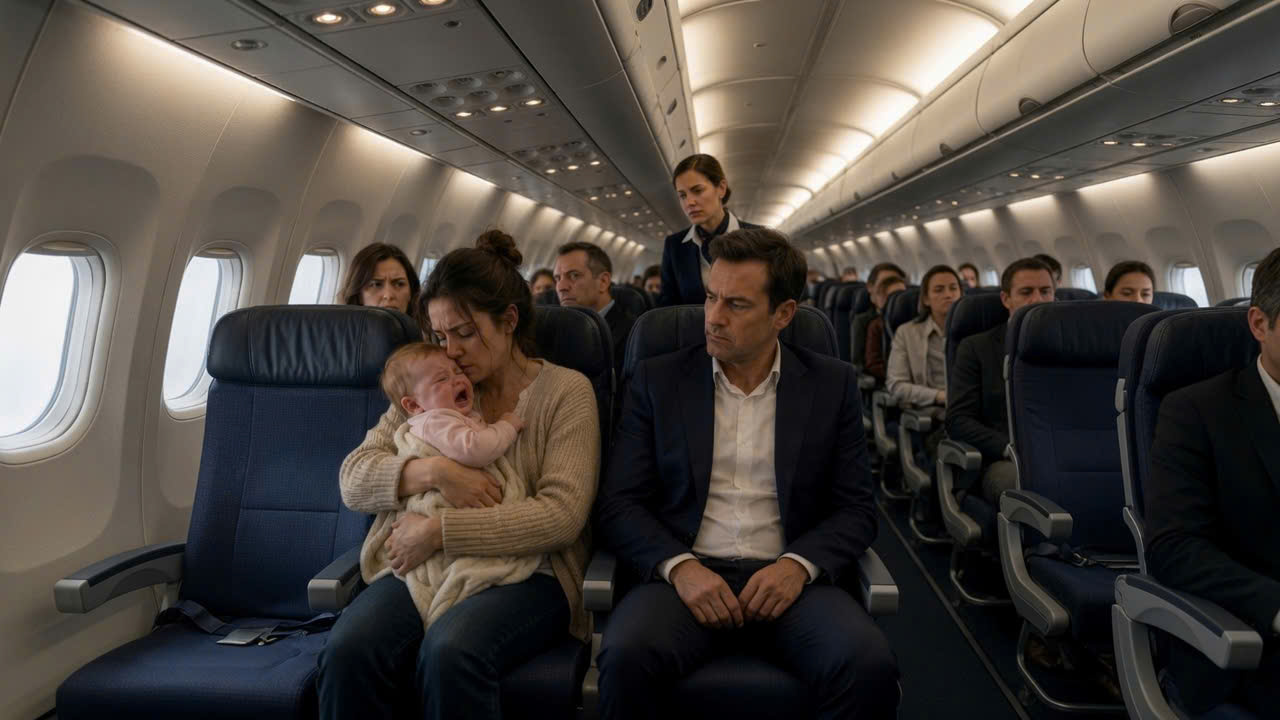
The baby’s cry sliced through the dark airplane cabin like an alarm no one wanted to hear.
Thirty thousand feet above the ground, trapped between rows of exhausted strangers and the endless black sky outside the windows, Elena held her daughter tightly against her chest and prayed the sound would stop.
But Lucia only cried harder.
Her tiny face had turned red, her little fists gripping the edge of her blanket as if she were trying to hold on to something in a world that already felt too frightening. Elena bounced her gently, whispered into her ear, kissed her warm forehead, and rocked her from side to side with the last strength left in her body.
“Shh, my love… please… please calm down,” she murmured, though her own voice was shaking.
Around them, the cabin began to stir.
A man two rows ahead twisted around with obvious annoyance. A woman across the aisle pressed her lips together and shook her head. Someone sighed loudly. Another passenger muttered something under his breath. The peaceful silence of the night flight had been broken, and everyone seemed to know exactly whom to blame.
Elena lowered her eyes, her face burning with shame.
She wished they could understand. She wished she had the strength to explain that she was not just a careless mother who had brought a crying baby onto a plane. She wished she could tell them that she had not slept properly in almost two days.
The past forty-eight hours had been a nightmare of hospital lights, cold examination rooms, worried doctors, test results, and words no mother ever wants to hear.
Lucia was sick.

No one in their town had been able to give Elena a clear answer. One doctor had finally looked at her with tired eyes and said there was a famous pediatric specialist in another country, four hours away by plane. He might be able to help. He might be their only chance.
So Elena had spent nearly everything she had on the ticket.
Now she was sitting on this flight with an aching back, trembling hands, and a heart full of fear, while her baby cried in her arms and strangers looked at her as if she had ruined their night on purpose.
Lucia let out another sharp cry.
This time, a voice came from somewhere nearby.
“People with babies shouldn’t even be allowed to fly.”
The words struck Elena harder than she expected.
She swallowed, blinking quickly so the tears would not fall. She adjusted Lucia’s blanket, tried to offer her comfort, tried to hold herself together. But her body was failing her. Her head felt heavy. Her vision blurred. Her arms ached from holding the baby for so long.
A flight attendant approached with a polite smile that did not quite hide her discomfort.
“Ma’am,” she said quietly, leaning closer, “some passengers are complaining. Is there anything you can do?”
Elena only nodded.
There was nothing she could say. No explanation felt strong enough. No apology felt useful. She could not tell everyone that she was terrified her daughter might be seriously ill. She could not ask an entire plane full of strangers to care.
So she kept rocking Lucia.
Minutes passed. The hum of the engines filled the silence between the baby’s cries. Elena’s eyelids grew heavier and heavier. She tried to fight it. She tried to stay awake. But exhaustion finally became stronger than fear, shame, and willpower.
Without realizing it, her head slowly tilted to the side.
Then, gently, helplessly, it came to rest on the shoulder of the man sitting next to her.
The man stiffened at once.
He had been silent the entire flight, his expression cold and irritated every time Lucia cried. He wore a dark coat, a silver watch, and the kind of tired, closed face that made people afraid to ask him for anything. Now he looked down at the exhausted mother leaning against him, then at the baby still trembling in her arms.
His jaw tightened.
For a moment, everyone nearby seemed to expect him to push her away.
But then the man moved.
Slowly, carefully, he slipped his arm behind Elena’s shoulders so her head would not fall. With his other hand, he reached toward the baby.
Elena woke with a start. “No—please, I’m sorry.”
The man did not look annoyed anymore.
His voice was low and steady. “You’re going to drop her if you keep fighting sleep.”
Elena froze.
“I won’t,” she whispered.
“You already nearly did.”
Her face went white.
Lucia cried again, weaker this time, a strained little sound that made the man’s eyes sharpen.
“May I?” he asked.
Elena clutched the baby tighter. “I don’t know you.”
“No,” he said softly. “But I know babies.”
Something in his voice was not cold now. It was wounded.
The passengers nearby had stopped pretending not to watch.
Elena looked down at Lucia. Her daughter’s breathing was uneven, her small chest rising too fast beneath the blanket. Elena’s fear finally outweighed her pride. Trembling, she let the man take the baby.
The entire plane fell silent.

The man held Lucia with surprising gentleness, supporting her head, lifting her slightly against his chest. He did not bounce her wildly or shush her in panic. He simply placed two fingers against the side of her neck and watched her face.
“What is her name?” he asked.
“Lucia.”
“How old?”
“Four months.”
“When did the crying start?”
“Two days ago. Fever first, then she stopped feeding well. The doctors said maybe infection, maybe something with her heart, maybe…” Elena’s voice broke. “They didn’t know.”
The man’s face changed.
Not with fear.
With recognition.
He pulled Lucia’s blanket back slightly. Her tiny lips were not red anymore.
They were turning faintly blue.
The man stood at once.
“Call the lead flight attendant,” he said sharply.
The flight attendant blinked. “Sir?”
“Now.”
His command cut through the cabin so cleanly that no one argued.
Elena rose too quickly, dizzy. “What’s happening?”
The man looked at her, and for the first time, she saw emotion crack through his controlled face.
“Your daughter isn’t crying because she’s disturbing people,” he said. “She’s crying because she cannot breathe properly.”
A ripple of shock moved through the rows.
The same man who had complained earlier looked down at his lap.
The lead flight attendant hurried over. “Is there a medical emergency?”
The man reached into his coat and pulled out an identification card.
“I’m Dr. Rafael Voss,” he said. “Pediatric cardiac surgeon. This child needs oxygen immediately, and the captain needs to contact emergency medical control. We may need to divert.”
Elena stared at him.
Rafael Voss.
The name struck her like lightning.
That was the specialist.
The famous doctor in another country.
The only man the hospital had told her might be able to save Lucia.
“You’re…” Elena could barely speak. “You’re him?”
His eyes flicked to her. “Yes.”
She grabbed the seatback to steady herself.
“I was flying to find you.”
For half a second, even Dr. Voss seemed stunned.
Then Lucia gave a tiny, broken gasp, and everything became motion.
The crew brought oxygen. A nurse from business class rushed back to help. Dr. Voss cleared a space across the row, laid Lucia gently on a blanket, and worked with the calm urgency of a man who had fought death many times and refused to be impressed by it.
“Keep her airway open,” he told the nurse. “Monitor her color. I need warm cloths. And get me the emergency kit.”
Elena stood frozen, useless and shaking.
Dr. Voss looked up. “Elena.”
She flinched. “How do you know my name?”
He nodded toward the boarding pass tucked into the seat pocket. “Your ticket.”
Then his voice softened. “I need you to breathe. Your baby can feel you panic.”
That broke her.
“I’m scared,” she whispered.
“I know,” he said. “But she is still fighting.”
The plane began to turn.
The captain’s voice came over the speaker, calm but tense, announcing a medical diversion. Around the cabin, complaints had vanished. The passengers who had glared at Elena now sat silent, their faces pale with guilt.
The woman across the aisle began to cry.
Elena knelt beside Lucia and whispered, “Mama’s here, my love. Please stay with me.”
Lucia’s eyes fluttered.
Dr. Voss listened to her chest with the stethoscope from the emergency kit. His expression grew darker.
“What is it?” Elena asked.
He hesitated just long enough to terrify her.
“She may have a congenital heart condition that went undetected. The crying and fever stressed her body. She needs a hospital the moment we land.”
“Will she die?”
The question came out before Elena could stop it.
Dr. Voss looked at Lucia, then at Elena.
“Not if I can help it.”
The plane landed forty minutes later in a city Elena had never been to. Ambulance lights flashed against the rain-slick runway. Paramedics rushed aboard. Dr. Voss never left Lucia’s side.
At the hospital, Elena signed papers with shaking hands. Nurses moved around her like shadows. Doors opened and closed. Machines beeped. Words flew past her—oxygen saturation, echo, valve obstruction, emergency procedure.
Then Lucia was taken away.
Elena stood alone in the hallway, staring at the swinging doors.
Dr. Voss remained beside her.
“I need to operate,” he said.
Her eyes filled. “You can save her?”
“I can try.”
“Please,” she whispered. “She’s all I have.”
Something painful crossed his face.
He looked down, and for the first time Elena noticed the small gold ring hanging from a chain around his neck.
A wedding ring.
Beside it was a tiny silver charm shaped like a baby shoe.
“I had a daughter once,” he said quietly.
Elena went still.
“Her name was Sofia. She would be twenty-four now.”
Elena’s heart twisted. “What happened?”
“My wife died giving birth. My daughter was taken from the hospital nursery two days later.”
Elena covered her mouth.
Dr. Voss’s voice remained controlled, but his eyes shone. “For years, I searched. Police searched. Private investigators searched. Nothing. Eventually, people told me to stop. They said she was gone.”
“I’m so sorry,” Elena whispered.
He looked toward the operating room. “I became a pediatric surgeon because I could not save my own child. So I spent my life saving everyone else’s.”
Then he disappeared behind the doors.
The surgery lasted three hours.
To Elena, it felt like three lifetimes.
She sat with Lucia’s blanket pressed against her chest, replaying every cruel glance on the plane, every moment she had nearly apologized for her child’s pain. At some point, the flight attendant came to the hospital too, still in uniform, eyes red.
“I’m sorry,” she said. “I should have helped sooner.”
Elena shook her head. “You didn’t know.”
The woman looked at Lucia’s blanket. “None of us wanted to know.”
Before dawn, Dr. Voss came out.
His surgical cap was in his hand. His face was exhausted.
Elena stood so quickly the blanket fell.
“She’s alive,” he said.
The world stopped.
Then Elena collapsed against the wall, sobbing.
Dr. Voss caught her before she fell.
“She’s stable,” he continued. “The next twenty-four hours matter, but she made it through.”
Elena cried into her hands. “Thank you. Thank you.”
But Dr. Voss was not smiling.
“Elena,” he said carefully, “during surgery, we found something unusual.”
Her tears slowed. “What?”
“Lucia’s heart defect is rare. Very rare. It often runs in families.”
Elena frowned. “But no one in my family had heart problems.”
He looked at her for a long moment.
“That’s what I thought too.”
She stared at him.
Dr. Voss reached into his pocket and took out a folded paper. It was a copy of Lucia’s emergency bloodwork, with genetic markers circled in red.
“My daughter had a birthmark,” he said, his voice suddenly unsteady. “Small. Crescent-shaped. Behind her left ear. It was noted in her newborn file.”
Elena’s stomach dropped.
Slowly, she lifted her hand to the side of her neck.
Behind her left ear was a faint crescent birthmark she had spent her whole life hiding beneath her hair.
“My adoptive mother said it was nothing,” Elena whispered.
Dr. Voss’s face crumpled.
“Elena,” he said, and now his voice was barely more than a breath, “what was your mother’s name?”
“My real mother?” Elena swallowed. “I don’t know. I was told I was abandoned as a baby. My adoptive parents said there were no records.”
Dr. Voss closed his eyes.
When he opened them again, tears spilled freely down his face.
“My daughter’s full name was Sofia Elena Voss.”
Elena stepped back.
“No.”
He nodded, trembling.
“Sofia for my wife. Elena because my wife loved the name.”
The hallway seemed to vanish around her.
For twenty-four years, Elena had believed she had been unwanted. Abandoned. A child left behind by people who could not love her.
But now the man standing before her—the stranger on the plane, the cold passenger, the doctor who had saved her baby—was looking at her as if she were the answer to every prayer he had ever made.
“You’re saying…” Her voice broke.
“I’m saying I think you are my daughter.”
Elena covered her mouth.
“I don’t understand.”
“I don’t either,” he said. “But I know this: Lucia has the same rare heart condition my family carries. You have the same birthmark. Your age matches. And the name…” His voice failed. “The name matches.”
Two weeks later, DNA confirmed what the heart had already known.
Elena was Sofia Elena Voss.
The stolen baby.
The lost daughter.
The miracle Dr. Rafael Voss had unknowingly sat beside on a midnight flight.
The investigation that followed uncovered the truth. A nurse from the old hospital had sold newborns through an illegal adoption network. Elena’s adoptive parents had not known the full crime; they had believed they were taking in a child whose mother had died and whose father had vanished. The woman who stole her had died years earlier, leaving only sealed files and ruined lives behind.
When Lucia finally opened her eyes in the recovery room, Elena sat beside her crib with Dr. Voss on the other side.
Lucia blinked up at them, tiny and tired, but alive.
Dr. Voss reached through the crib bars and touched her little hand.
“My granddaughter,” he whispered, his voice breaking.
Elena looked at him through tears.
On the plane, she had thought the world had turned against her.
But the truth was impossible.
Her baby’s cry had not ruined the flight.
It had awakened the only man on board who could save her.
And more than that, it had led Elena back to the father who had never stopped searching for her.
Months later, when Lucia was healthy enough to fly home, Elena boarded another plane with Dr. Voss beside her.
This time, when Lucia fussed softly, no one complained.
Dr. Voss smiled, lifted the baby into his arms, and whispered, “Cry if you need to, little one. That is how we found each other.”
Elena leaned her head against her father’s shoulder.
Not from exhaustion this time.
From peace.
Outside the window, dawn spread across the clouds like gold.
And for the first time in her life, Elena understood that some cries are not interruptions.
Sometimes, they are calls for the people who were meant to find us.
Leave a Reply