
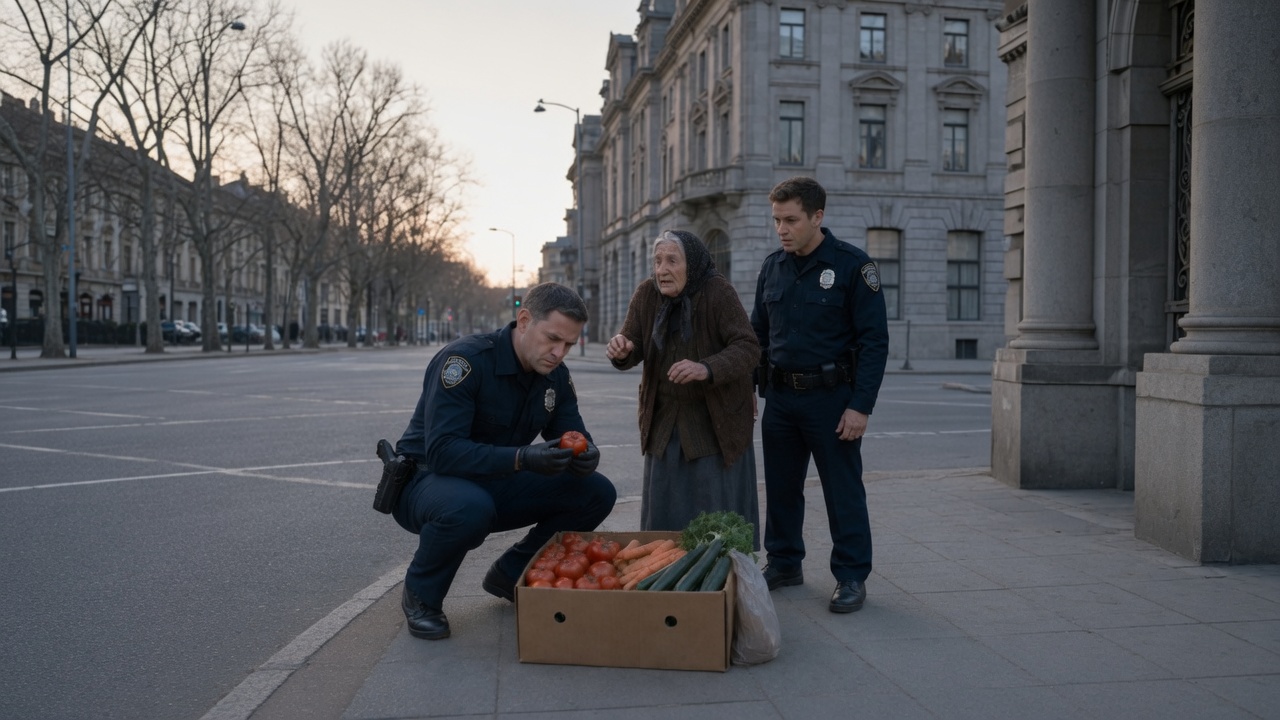
The first tomato did not bleed like fruit.
When Sergeant Adrian Cross pushed his thumb through the smooth red skin, he expected pulp, seeds, the wet smell of a garden in early summer. Instead, something hard and metallic clicked beneath his thumb, and the old woman beside him let out a sound so small, so terrified, it might have been mistaken for a prayer.
Officer Noah Bell, younger by twenty years and softer in all the places Adrian had learned to harden, stared at him.
“Sergeant?” Noah asked. “What is it?”
Adrian did not answer immediately.
The street around them had gone strangely quiet. Cars passed. Shoes scraped across the pavement. A traffic light changed from green to yellow to red. But in that moment, all Adrian could hear was the old woman breathing.
Too fast.
Too shallow.
Like someone waiting for a gunshot.
Only fifteen minutes earlier, she had looked like the saddest person on the entire block.
A thin elderly woman in a gray sweater, standing beside a flattened cardboard box full of vegetables: tomatoes, carrots, cucumbers, all arranged in careful rows on a blue cloth. Her white hair escaped from beneath a knitted hat. Her shoulders curved inward as if life had pressed down on them for decades and finally won.
The call had been simple. Illegal street trading near the main road. A vendor blocking the sidewalk. No license.
Adrian had expected irritation. Noah had expected paperwork.
Neither of them had expected pity.
“Ma’am,” Adrian had said gently, “you can’t sell here without permission.”
The woman lowered her head. Her hands, swollen at the knuckles, trembled against the box.

“I know, my dear,” she whispered. “But what else can I do? My son is sick. He needs medicine every week. I have no husband. No family. No one.”
Noah’s expression had changed immediately. Adrian saw it happen—the softening around the eyes, the quiet guilt, the instinctive need to save someone who looked breakable.
“I grew them myself,” she added, pointing at the vegetables. “In my little garden. I only need enough for medicine.”
Adrian had seen lies before. He had heard thousands of them—messy lies, arrogant lies, desperate lies. But this one had worn poverty so well that even he nearly believed it.
Nearly.
They were about to let her go with a warning when Noah smiled and said, “Since we’re already here, we’ll buy a few tomatoes.”
That was when everything changed.
The old woman’s head snapped up.
“No.”
The word came too quickly.
Noah blinked. “No?”
“I mean… no need, dear. Others will buy.”
Adrian looked down the empty sidewalk. “What others?”
“They come in the morning,” she said.
“It is morning.”
Her lips tightened.
Then Adrian bent toward the box, and she lunged forward with a panic that did not belong to hunger, poverty, or shame.
“Don’t touch them!”
Now, with the tomato split beneath his thumb and a metallic object hidden inside the flesh, Adrian understood one thing with perfect clarity.
This was not a vegetable stand.
He took out his pocketknife and cut the tomato open.
A tiny silver capsule rolled into his palm, slick with juice.
Noah’s face went pale. “Drugs?”
Adrian shook the capsule gently. Something rattled inside.
The old woman made a desperate move for the box.
“Noah,” Adrian said.
Noah caught her wrist before she could grab it.
“Please,” she gasped. “Please, you don’t understand.”
Adrian opened the capsule.
Inside was not powder.
Not pills.
Not diamonds.
It was a baby tooth, wrapped in a strip of waterproof paper.
Noah leaned closer, confused and horrified.
On the paper, written in tiny black letters, was a name.
MARA ELLIS — AGE 4 — MISSING: 2009
For a moment, neither officer moved.
Then Adrian cut open another tomato.
Another capsule.
Another tooth.
Another name.
JONAH PRICE — AGE 6 — MISSING: 2011
Another.
LENA VOSS — AGE 3 — MISSING: 2014
Noah stepped back as if the box had become alive. “What the hell is this?”
The old woman closed her eyes.
Adrian’s voice turned cold.
“Arrest her.”
Noah hesitated only one second before snapping the handcuffs around her thin wrists. She did not fight anymore. She simply stared at the tomatoes with tears running silently down her wrinkled cheeks.
“They were supposed to be found,” she whispered.
Adrian heard her.
But he said nothing.
At the station, the mood changed from irritation to horror within minutes.
The vegetables were taken to the evidence room. Every tomato was weighed, photographed, sliced open. By noon, twenty-eight capsules sat beneath the fluorescent lights.
Twenty-eight baby teeth.
Twenty-eight names.
Twenty-eight missing children.
Some cases were famous enough that every officer knew them. Posters had once covered bus stops and grocery store windows. Mothers had cried on television. Fathers had begged into microphones. Candlelight vigils had filled church steps. Then years passed, leads died, and the city did what cities always did.
It moved on.
But the teeth had not moved on.
They had been hidden inside tomatoes, carried through traffic by a trembling old woman who claimed to need medicine for her sick son.
Captain Ruiz entered the evidence room with a face like stone.
“Who is she?”
Noah looked at the file. “No ID. No wallet. She says her name is Agnes Miller.”
Adrian stood near the table, arms crossed. “She’s lying.”
The old woman sat behind the glass in Interview Room Two, still wearing her gray sweater. Without the tomato box beside her, she seemed even smaller. A grandmother. A beggar. A ghost.
Captain Ruiz looked through the glass.
“She doesn’t look strong enough to hurt a child.”
Adrian’s jaw tightened. “That’s why no one looked at her.”
Noah said nothing.
He could not stop staring at the names.
One of them had been his first missing-person case, back when he was a rookie. Lena Voss. A little girl with yellow rain boots. He had never found her. He had never forgotten the sound her mother made when the search was called off.
Now Lena’s baby tooth sat in a capsule under police lights.
Adrian entered the interview room first.
The old woman looked up.
“Agnes Miller,” he said.
She gave a faint smile. “That is what people call me now.”
“What did they call you before?”
Her smile disappeared.
Adrian placed one capsule on the table.
“Where are the children?”
Her hands curled into fists.
“Gone,” she whispered.
Noah, standing by the door, felt something crack in his chest.
“Gone where?” he demanded.
She looked at him then, really looked at him, and her expression changed.
For the first time, Noah saw not fear in her face, but recognition.
“My God,” she breathed. “You have his eyes.”
Adrian turned slightly. “Whose eyes?”
The woman ignored him.
“Noah,” she said softly.
He froze.
He had not told her his name.
Adrian noticed too.
“How do you know him?”
The old woman’s tears returned.
“Because I held him before anyone else did.”
Noah felt the room tilt.
“What?”
The woman leaned forward as far as the cuffs allowed.
“Your name was not Noah Bell,” she whispered. “It was Samuel Hart.”
The silence that followed was worse than a scream.
Adrian slapped his palm on the table. “Enough games.”
But the old woman was looking only at Noah.
“You were born at Saint Orla’s Hospital on April ninth, nineteen ninety-five. Your mother was seventeen. She named you Samuel because it meant God had heard her.” Her voice broke. “Then someone took you from the nursery before sunrise.”
Noah shook his head. “No. I was adopted.”
“Yes,” she said. “After you were stolen.”
The word struck him so hard he stepped backward.
Adrian leaned over the table. “You expect us to believe that?”
“No,” she said. “I expect you to open the black tomato.”
Noah blinked. “What black tomato?”
Her eyes flicked toward Adrian.
“The one he slipped into his coat.”
For one terrible second, no one moved.
Then Noah slowly looked at Adrian.
Adrian’s face was unreadable.
“What is she talking about?” Noah asked.
Adrian gave a dry laugh. “She’s trying to divide us.”
“Empty your coat.”
“Officer Bell,” Adrian said sharply.
“Empty it.”
Adrian’s hand moved toward his sidearm.
Noah moved faster.
He drew his gun.
The old woman flinched. Adrian stared at his partner, disbelief burning in his eyes.
“You’re making a mistake,” Adrian said.
“No,” Noah replied, voice shaking. “For once, I think I’m asking the right question.”
Captain Ruiz burst in seconds later with two officers behind him. Adrian was ordered to raise his hands. He refused until Ruiz pulled the black tomato from the inner pocket of his coat.
It was not ripe.
It was not rotten.
It had been painted black.
Inside was a larger capsule.
Inside the capsule was a flash drive and a faded hospital bracelet.
The bracelet read:
SAMUEL HART — MALE — 04/09/1995
Noah could not breathe.
Ruiz plugged in the drive.
The video that appeared had been recorded twenty-nine years earlier.
A hospital nursery. Rows of sleeping newborns. A younger Adrian Cross, not yet a sergeant, stood beside a doctor in a white coat. He was smiling. In his arms was a baby wrapped in blue.
Noah’s hands began to shake.
The doctor spoke on the recording.
“Subject thirteen. Healthy. High demand.”
A woman behind the camera sobbed, “Please. Please don’t take my baby.”
Adrian’s younger face turned toward her.
“You signed the papers.”
“I can’t read!”
“You signed,” he repeated.
Then he carried the baby out.
The screen went black.
Noah lowered himself into a chair before his knees failed.
The old woman was crying openly now.
“I was a nurse,” she said. “I helped deliver you. I thought the babies were being placed with families because their mothers couldn’t care for them. Then I saw the payments. The forged papers. The graves.”
“Graves?” Ruiz asked.
“For the mothers who fought back,” she whispered.
Noah looked at Adrian.
The sergeant’s expression had changed. The mask was gone. Beneath it was not shame.
It was annoyance.
“You stupid old woman,” Adrian said quietly. “You should have died in that fire.”
The room went still.
Ruiz’s officers seized him.
Adrian laughed once, bitter and ugly.
“You think this ends with me? Half the city was built on those adoptions. Judges. Doctors. Politicians. Families who paid to forget where their children came from.”
Noah stood slowly.
“My mother,” he said. “Where is she?”
The old woman closed her eyes.
“She looked for you for three years. Then she disappeared. I found her name in a ledger marked ‘uncooperative.’ I am so sorry.”
Noah’s face emptied.
For years, he had believed his life was ordinary. A loving adoptive home. A career in uniform. A name stitched onto his chest.
Now that name felt like stolen clothing.
Ruiz ordered Adrian taken away. As officers dragged him through the door, he turned his head and smiled at Noah.
“You wanted justice?” he said. “Then arrest your whole life.”
The door slammed behind him.
Only the old woman remained.
Noah stared at her through the blur in his eyes. “Why the tomatoes?”
She gave a broken laugh.
“Because no one searches a poor woman’s food. Because the market is where grieving mothers used to meet me. Because tomatoes stain like blood, and I wanted someone to finally see.”
“But why today?”
Her gaze softened.
“Because I saw your photo in the newspaper last week. Officer Noah Bell, honored for service.” She swallowed. “I knew your face. I knew your eyes. And I knew if I walked into this station with evidence, Adrian would bury me before sunset.”
“So you called in the complaint yourself,” Ruiz said.
She nodded.
“I needed honest officers to find the box in public. I needed handcuffs. Cameras. Witnesses.” Then she looked at Noah. “And I needed my son to know the truth.”
Noah stiffened. “Your son?”
The old woman reached into the sleeve of her sweater with trembling fingers. Ruiz moved forward, but she only pulled out a folded photograph.
A young nurse stood outside Saint Orla’s Hospital, holding a newborn. On the back, written in fading ink, were four words:
Samuel, forgive your mother.
Noah stared at the photograph.
The nurse’s face was younger, fuller, untouched by time and terror.
But the eyes were the same.
The old woman was not merely the witness.
She was not merely the nurse.
She was the seventeen-year-old girl from the video.
She was his mother.
Noah’s breath shattered.
“You said you delivered me.”
“I did,” she whispered. “Alone, in a storage room, before they took you. I became a nurse years later under a false name so I could find where you had gone.”
“You let me think you were part of it.”
“I was part of it,” she said, tears falling. “Every day I stayed silent, I was part of it. Every child I couldn’t save, every mother I was too afraid to help… I carried them all. So I carried their teeth too.”
Noah covered his mouth.
All his training, all his discipline, all his years of being the calm one vanished.
He stepped toward her.
She lifted her cuffed hands as if she expected him to strike her.
Instead, he knelt in front of her.
For a long moment, neither of them spoke.
Then Noah reached for the cuffs.
Ruiz gently stopped him.
“Not yet,” the captain said. “There has to be a process.”
Noah nodded, but his eyes never left hers.
“What medicine did you need?” he asked.
She smiled sadly.
“I told one true lie,” she said. “My son was sick. Not his body. His life. His name. His past. He had been living with a wound he could not see.”
Outside the station, rain began to fall.
By evening, the story had broken across every screen in the city. Arrests began before midnight. Doctors fled. Judges resigned. Families locked their doors as if truth were a burglar.
And in the evidence room, the tomatoes remained under glass, split open and red beneath the lights.
Not vegetables.
Not merchandise.
Graves small enough to fit in a palm.
Messages from children the city had buried without coffins.
At dawn, Noah stood alone before them.
He had spent his life believing monsters came with weapons, masks, and blood on their hands.
But the woman in the gray sweater had taught him something worse.
Sometimes monsters wore badges.
Sometimes mothers wore guilt.
And sometimes, justice arrived in a cardboard box of tomatoes, carried by an old woman who had already lost everything except the courage to be arrested.
Leave a Reply