
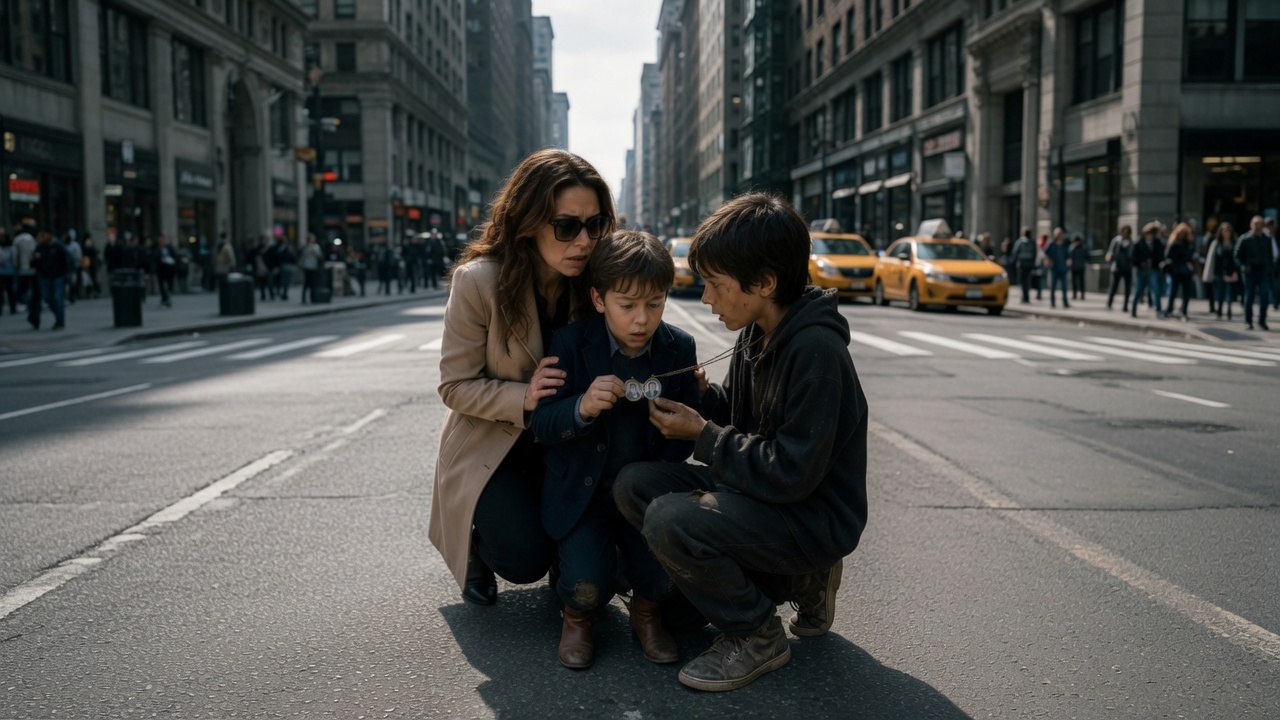
“Mom… that kid…”
The words were so soft they should have vanished beneath the roar of Manhattan traffic. Instead, they sliced straight through the city noise and stopped Vivian Ashford’s heart.
She had been walking fast, one gloved hand resting on her son’s shoulder, the other gripping the leather strap of a handbag that cost more than most people’s rent. Around them, Manhattan rushed on with its usual cold indifference — yellow taxis gliding past the curb, office workers brushing by with paper cups of coffee, tourists laughing beneath bright billboards, and winter wind whipping between glass towers like a warning.
Vivian almost kept walking.
Almost.
But her son, Oliver, had stopped.
The ten-year-old stood stiffly beside her, his face pale beneath his neat navy cap. He wasn’t looking at the toy store window they had just passed. He wasn’t staring at the glowing screens or the honking taxis. His frightened eyes were fixed on a street pole near the curb.
A boy sat there.
He was barefoot.
His knees were bruised and dirty. His oversized charcoal hoodie hung from his thin body like it belonged to someone twice his size. His lips were cracked from the cold, and his messy dark hair fell into eyes that looked far too tired for a child.
Then the homeless boy looked up.
Vivian’s breath caught so violently it hurt.
For one impossible second, the world narrowed to that boy’s face.
The same eyes. The same mouth. The same delicate chin. The same crease between the brows when confused.
It was Oliver.
No — not Oliver.
But the resemblance was so exact, so cruelly perfect, that Vivian felt as if the sidewalk had split open beneath her expensive shoes.
Oliver stepped forward before she could stop him.
“He looks like me,” he whispered.
The homeless boy stared at him without blinking.
Vivian’s fingers tightened on Oliver’s shoulder until he winced.
“Mom?” Oliver looked up at her. “Why does he look like me?”

Vivian opened her mouth, but no words came. Her throat had closed around something old and buried. Something she had forced herself not to remember for ten years.
The homeless boy slowly pushed himself to his feet.
He did not beg. He did not ask for money. He did not reach for food.
Instead, he lifted one trembling hand to his neck.
A locket hung there on a tarnished chain.
Vivian stepped back as if he had drawn a weapon.
“No…” she breathed.
The boy unclasped it carefully, reverently, like it was the only thing in the world that had ever belonged to him. Then he held it out to Oliver.
Oliver took it with both hands.
His fingers shook as he opened it.
Inside were two tiny photographs.
Two newborn babies wrapped in blue blankets.
And beneath them, carved into the faded metal, were the words:
“To our twin sons.”
Oliver’s face crumpled.
“Mom…” His voice broke. “Tell me what this means.”
Vivian stared at the locket. She had seen it before. Not in a dream. Not in a memory softened by time.
She had worn it around her own neck in the hospital.
The homeless boy looked at her with guarded, exhausted eyes.
Then he whispered one word.
“Mother?”
The sound broke something inside her.
Vivian staggered backward. A businessman cursed as he nearly bumped into her, then hurried away when he saw her face. Oliver turned from the locket to his mother, terror blooming in his eyes.
“Mom?” he asked again. “Is he my brother?”
Vivian wanted to lie.
She had spent ten years living inside a lie so polished, so expensive, so protected by lawyers and locked doors, that sometimes she almost believed it.
But the boy’s eyes were her punishment.
She sank to her knees on the filthy sidewalk, heedless of the grime staining her cream wool coat.
“What is your name?” she whispered.
The homeless boy hesitated.
“Eli.”
Vivian covered her mouth.
Oliver stared between them. “You know that name?”
Vivian nodded slowly, tears spilling down her face.
“When you were born,” she said, her voice barely audible, “there were two of you.”
Oliver stopped breathing.
Vivian reached for him, but he stepped back.
She swallowed the sob rising in her throat. “The doctors told me your brother didn’t survive. Your father told me there was nothing I could do. They said he had been taken away before I woke from surgery.”
Eli’s expression changed. It was not relief. It was worse.
It was recognition.
“My father?” Oliver whispered. “Dad knew?”
Vivian closed her eyes.
A black town car pulled up beside the curb.
The rear door opened.
Marcus Ashford stepped out.
Vivian’s husband looked exactly as he always did — silver hair perfectly combed, dark coat tailored to his broad shoulders, phone in one hand, impatience in his jaw. He was a man who commanded rooms without raising his voice. A man who donated to hospitals and appeared on charity boards. A man whose name was etched on museum walls.
He froze when he saw the three of them.
His eyes moved from Vivian to Oliver.
Then to Eli.
For the first time in all their marriage, Vivian saw real fear in his face.
“What is this?” Marcus asked, but his voice lacked its usual power.
Eli shrank back.
Vivian stood slowly. “That’s what I want to know.”
Marcus looked at the locket in Oliver’s hands. His skin turned gray.
“Give that to me,” he said.
Oliver clutched it against his chest. “No.”
Marcus’s eyes sharpened. “Oliver, do as I say.”
“No!” Oliver shouted, and the word startled even him. “Is he my brother?”
People began slowing down now. Phones appeared. Manhattan loved a spectacle, especially when the rich began bleeding in public.
Marcus stepped closer. “Vivian, get in the car.”
She did not move.
“Tell me,” she said.
His jaw tightened. “Not here.”
“Tell me now.”
Marcus’s gaze flicked toward Eli with cold disgust. “This child is confused. There are scams everywhere in this city.”
Eli’s shoulders folded inward as if he had been struck.
Vivian saw it.
The boy had heard that tone before.
Her voice dropped. “You knew he was alive.”
Marcus said nothing.
Oliver looked at his father, horror dawning slowly. “Dad?”
Marcus exhaled through his nose. “It was necessary.”
The sidewalk seemed to tilt.
Vivian whispered, “Necessary?”
Marcus lowered his voice. “The doctors said one of the twins might have a severe condition. We had investors, a merger, public scrutiny. My father was still alive. He would have cut us off if there had been scandal, hospital complications, legal exposure—”
Vivian slapped him.
The crack echoed louder than the traffic.
Marcus’s head turned with the blow. Around them, people gasped.
“You threw away our baby because he might be sick?” Vivian said.
Marcus looked back at her, anger rising. “I arranged for placement. A private adoption. He was supposed to be cared for.”
Eli laughed once.
It was a small, broken sound.
“Cared for?” he said.
Vivian turned to him.
Eli’s fingers twisted in the hem of his dirty hoodie. “The woman who had me died when I was six. Then there were shelters. Then men who said they knew my father. They took the papers. They took everything except the locket because I hid it in my shoe.”
Vivian made a sound like she had been wounded.
Oliver stepped beside Eli before anyone else moved.
He looked at Marcus with tears shining in his eyes. “You left him.”
Marcus’s face hardened. “I protected this family.”
“No,” Vivian said. “You protected your name.”
Then Eli reached into his hoodie.
Marcus flinched.
But Eli only pulled out a folded envelope, sealed in a plastic sleeve. It was worn, creased, and taped at the edges.
“A woman at the shelter told me to keep this safe,” he said. “She said if I ever found the lady in the photo, I should give it to her.”
Vivian took the envelope with shaking hands.
Inside was a letter.
The handwriting was unfamiliar, but the hospital logo at the top was not.
Vivian read the first line.
Then her knees nearly gave out.
Mrs. Ashford, if you are reading this, your child was not stillborn.
The street sounds dissolved.
The letter was from a nurse named Teresa Bell. She had written that Marcus Ashford had paid a doctor to falsify records, that the second baby had been discharged under another woman’s name, and that Vivian had been kept sedated until the paperwork was done.
Vivian read on, each sentence a blade.
Then she reached the final paragraph.
Her blood turned cold.
There is one more thing you must know. The child they kept may not be the child they intended to keep. The identification bracelets were switched in the emergency unit before Mr. Ashford arrived. I did it because I knew he would choose the “healthy” baby and abandon the other. I switched them to save the weaker child.
Vivian looked up.
Marcus stared at her, confused by her expression.
Oliver whispered, “Mom?”
Vivian read the final line aloud, her voice trembling so badly the words almost broke apart.
“The boy raised in your home is the baby Mr. Ashford meant to throw away.”
Silence fell.
Even Manhattan seemed to pause.
Marcus’s face went slack.
Oliver stared at Vivian. Eli stared at Oliver.
The truth landed between them like lightning.
Marcus had not merely abandoned one son.
He had abandoned the son he thought was imperfect — and unknowingly raised him as his heir.
Oliver’s lips parted. “He wanted to get rid of me?”
Vivian grabbed him, pulling him into her arms. “No. No, my love. Not you. Never you.”
But Oliver wasn’t looking at her.
He was looking at Marcus.
The man who had taught him to tie a tie. The man who had signed his birthday cards with a secretary’s pen. The man who had smiled for photographs and called him “legacy.”
Marcus took one step toward him. “Oliver, listen to me—”
Oliver stepped behind Vivian.
Eli did too.
That small movement shattered Marcus more completely than the slap.
For the first time, both boys stood on the same side.
Vivian folded the letter and placed it inside her coat pocket. Then she took out her phone.
Marcus’s eyes narrowed. “What are you doing?”
“Calling my lawyer.”
“Vivian.”
“And the police.”
His mask finally cracked.
“You have no idea what you’ll destroy,” he hissed.
Vivian looked at the two boys — one polished and trembling, one barefoot and bruised — and felt ten stolen years rise like fire in her chest.
“Yes,” she said. “I do.”
Police arrived fifteen minutes later.
By then, the video had already spread across the city. The billionaire philanthropist. The missing twin. The forged hospital records. The homeless child with the locket.
Marcus tried to leave.
He did not get far.
As officers placed him in the back of a patrol car, he looked once at Oliver, expecting loyalty, confusion, weakness — something he could use.
But Oliver only held Eli’s hand.
“Is he coming home with us?” Oliver asked Vivian.
Eli stiffened, as if afraid the answer might hurt more than the cold.
Vivian knelt before him. Her coat was stained. Her makeup was ruined. Her world had collapsed in the middle of a Manhattan sidewalk.
But her voice was steady.
“If you’ll let me,” she whispered, “I would like to spend the rest of my life making it home.”
Eli’s guarded face trembled.
“I don’t know how to be your son,” he said.
Vivian touched his cheek with shaking fingers. “Then we’ll learn together.”
Oliver held out the locket.
Eli looked at it, then slowly closed both boys’ hands around it.
“It says twin sons,” Oliver whispered. “That means both of us.”
For the first time, Eli smiled.
Small. Uncertain. Beautiful.
Six months later, the Ashford name was no longer on hospital wings or charity galas. Marcus’s empire was under investigation, and the doctor who had signed the false death certificate had lost everything. Teresa Bell, the nurse who had switched the bracelets, was found living quietly in Queens. Vivian visited her once.
“Why did you switch them?” Vivian asked.
The old nurse wept. “Because he came into that nursery and pointed at one baby like he was choosing a watch. He said, ‘That one looks stronger.’ I knew what men like him did to anything they considered weak.”
Vivian thought of Oliver, gentle and anxious and endlessly kind.
Then of Eli, fierce and wounded and still brave enough to hope.
The nurse had not saved one child.
She had saved them both.
On the boys’ eleventh birthday, Vivian gave them each a new chain for the old locket. They refused to keep it apart. Instead, they hung it in a frame beside a photograph taken that morning.
In the photo, Oliver and Eli stood shoulder to shoulder in matching navy sweaters, their identical smiles no longer frightening, no longer impossible.
Just true.
That night, Vivian found them asleep on the living room couch, heads tilted toward each other, the way newborn twins sometimes do before the world teaches them separation.
She stood in the doorway and cried silently.
Not because of what had been lost.
Because of what had come back.
And because the most shocking truth was not that Marcus had thrown away his son.
It was that, in trying to choose the stronger child, he had proven he never understood strength at all.
Leave a Reply