
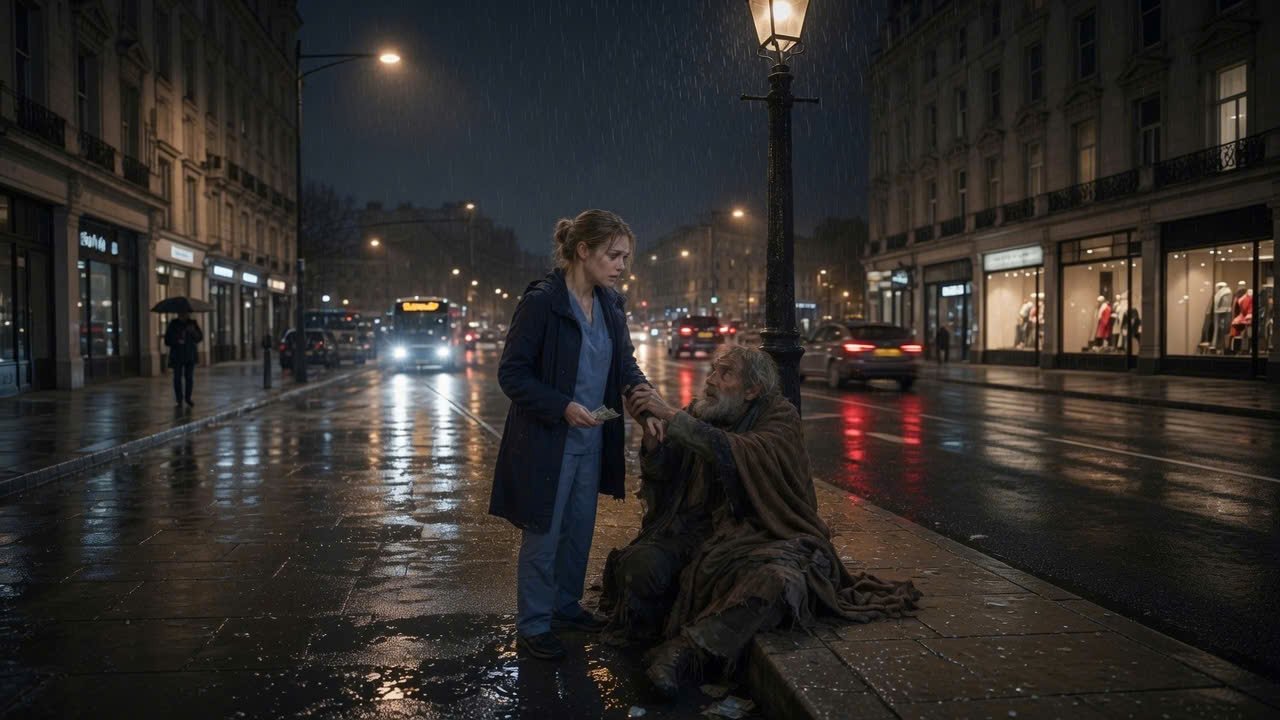
The Homeless Man Told Me Not to Sleep in My Bed. By Morning, I Discovered My Dead Husband Had Been Sitting Under That Streetlamp All Along.
Some warnings don’t sound like warnings at first.
Sometimes, they come from the kind of person the world teaches you not to notice.
For almost a year, I passed the same homeless man every evening after work. And every evening, without fail, I gave him something—coins at first, then a few bills, sometimes hot tea, sometimes a sandwich from the hospital cafeteria.
I never imagined that one rainy night, the man everyone ignored would grab my arm and whisper the sentence that would save my life.
“Don’t sleep at home tonight. Not in your bed. Tomorrow I’ll explain everything.”
At the time, I thought grief had finally made the world feel stranger than it was.
My shift at the city hospital always ended late. By the time I stepped outside, the sky was usually dark, the streets slick with light, and my body so tired that even breathing felt heavy. I worked long hours because I had to, but also because work was the only place where I could outrun my memories.
After my husband died, home stopped feeling like home.
It became a museum of everything I had lost.
His coat still hung near the door. His books still leaned unevenly on the shelf. His side of the bed remained untouched, as if some foolish part of me believed that if I left it exactly the same, he might walk back in one day and laugh at me for worrying.
But Adrian never came back.
So I worked. I healed strangers. I smiled at patients. I held families together while mine had quietly fallen apart.
And every night, on my way home, I passed the same intersection.
Beside an old streetlamp sat the homeless man.
He was always there.
In summer, the sun burned his skin. In autumn, rain soaked through his thin clothes. In winter, he wrapped himself in a faded, threadbare blanket and pressed his hands together for warmth. Yet he never moved from that spot.
In front of him lay the same cardboard sign, the edges curled from weather and time.
For food and medicine.
I never walked past without stopping.
He was quiet, almost painfully so. When I gave him money, he nodded. When I brought food, he thanked me softly. He never begged harder, never followed me, never asked questions. We became familiar strangers, connected by a few seconds each evening.
I didn’t know his name.
He didn’t know mine.
Or at least, I thought he didn’t.
That night, the rain was coming down in heavy sheets. Cars crawled along the road, their headlights stretching across the puddles like trembling gold. My shoes were soaked, my hair clung to my face, and all I wanted was to get home, take a shower, and collapse into bed.
I saw him under the streetlamp, hunched beneath his old blanket.

Something about him looked different.
Usually, he kept his eyes lowered. But that night, he was watching me before I even reached him.
I stopped anyway.
I pulled a few damp bills from my coat pocket and placed them in his hand.
“Please get something warm,” I said.
I turned to leave.
Then his fingers closed around my wrist.
Not hard enough to hurt me.
But hard enough to freeze me in place.
My heart jumped.
He had never touched me before.
When I looked down, his face had changed. The softness was gone. His eyes were sharp, terrified, almost desperate.
“Listen to me,” he whispered.
I swallowed. “What’s wrong?”
“Don’t sleep in your bed tonight.”
The rain seemed to grow louder.
I stared at him, certain I had misheard. “What?”
“Don’t go home and sleep there. Not tonight. Stay somewhere else. Anywhere else.”
A cold uneasiness crept up my spine.
“How do you know where I live?”
He didn’t answer.
Instead, his grip tightened just slightly, and his voice dropped even lower.
“Tomorrow, I’ll explain everything. But tonight, you must trust me.”
I tried to pull away. “You’re scaring me.”
“I know.” His eyes filled with something I couldn’t understand. “But fear will keep you alive.”
For a moment, neither of us moved.
Rain dripped from the edge of the streetlamp. Cars hissed past behind me. The city kept breathing as if nothing had changed.
Then he let go of my arm, lowered his head, and became silent again.
I stood there trembling, staring at him.
Every sensible part of me said he was confused, maybe unstable, maybe lost in some nightmare of his own.
So I walked away.
But I did not forget his words.
By the time I reached my apartment building, my hands were shaking so badly that I dropped my keys twice. I told myself I was being ridiculous. I told myself grief made people superstitious. I told myself a homeless man could not possibly know anything about my bedroom.
Still, when I stepped inside, the apartment felt wrong.
Nothing had changed.
And that was exactly what frightened me.
Adrian’s coat hung by the door. The books sat on the shelf. The framed photograph from our wedding leaned beside the lamp. My bed waited at the end of the hall, neat and untouched, his side still smooth beneath the pale blue blanket.
I locked the door.
Then I locked it again.
I took a shower, changed into dry clothes, and stood in the bedroom doorway, staring at the bed.
Don’t sleep in your bed tonight.
The words crawled through my mind.
I almost laughed at myself.
Almost.
Then I did something I still believe saved me.
I pulled two spare pillows from the closet, placed them beneath the blanket in the shape of a sleeping body, and switched off the bedroom light.
Then I took my phone, went into the hallway closet across from the bedroom, and sat on the floor among winter coats and old boxes.
I told myself I would sit there for ten minutes.
Just ten.
At 2:13 a.m., I heard the front door click.
Not a knock.
Not a forced entry.
A key.
My blood turned cold.
The door opened slowly.
A thin line of hallway light slid across the floor.
I pressed both hands over my mouth.
Someone stepped inside.
I could hear the soft weight of shoes on the floorboards. Whoever it was moved carefully, confidently, as if they knew exactly where everything was.
They did not search the living room.
They did not call my name.
They walked straight toward the bedroom.
The door creaked.
The figure paused beside my bed.
Through the narrow crack of the closet door, I saw only a dark coat, gloved hands, and the shine of something metal.
My lungs locked.
The figure leaned over the blanket.
For one horrifying second, I thought I was watching a nightmare from outside my own body.
Then the gloved hand drove the metal object down into the pillow where my chest would have been.
Once.
Twice.
Again.
I bit my palm so hard I tasted blood.
The figure froze.
Maybe they heard me.
Maybe grief had made me breathe too loudly.
Slowly, they turned toward the closet.
My phone was already in my hand.
I pressed emergency call.
The tiny sound of the connecting tone seemed louder than thunder.
The figure rushed toward me.
I screamed.
The closet door flew open.
A masked face loomed above me.
Then sirens wailed outside.
The figure cursed and ran.
By the time the police arrived, I was on the floor, shaking so violently one officer wrapped his jacket around my shoulders.
They found the pillows ripped apart.
They found a strange chemical smell on the blanket.
They found no broken locks, no shattered windows, no sign of forced entry.
Whoever had entered my home had a key.
When Detective Warren asked if anyone else had access, I could barely speak.
“My husband,” I whispered automatically.
Then I remembered.
“My husband is dead.”
The detective looked at me for a long moment.
“Who warned you?”
I thought of the man under the streetlamp.
The trembling hands.
The desperate eyes.
Tomorrow, I’ll explain everything.
“I don’t know his name,” I said. “But he knew.”
At sunrise, two officers drove me back to the intersection.
The streetlamp was still there.
The wet pavement gleamed.
But the homeless man was gone.
His cardboard sign remained, weighted down by a stone.
Beneath it was a folded paper in a plastic bag.
My name was written across it.
Emma.
My hands went numb.
I opened the note.
If you survived, come to St. Jude’s Chapel before noon. Do not trust anyone who says Adrian’s case was closed.
I read the sentence three times.
Adrian’s case.
Not his death.
His case.
The chapel stood six blocks away, old and nearly abandoned, wedged between a pawnshop and a closed theater. Rainwater dripped from its cracked stone roof. Inside, candles burned weakly in red glass cups.
The homeless man sat in the last pew.
Without his blanket, he looked even thinner. His head was bowed. His hands were clasped so tightly his knuckles were white.
When I stepped closer, he looked up.
“Emma,” he said.
I stopped.
No one called me that anymore.
At the hospital, I was Nurse Hale. To neighbors, Mrs. Reed. After Adrian died, even my own name had begun to sound like it belonged to someone else.
“How do you know my name?” I asked.
His eyes glistened.
“Because he said it every day.”
My breath caught. “Who?”
“Your husband.”
The chapel seemed to tilt around me.
I gripped the edge of the pew. “Don’t say that.”
“I’m sorry.”
“Don’t you dare use him to scare me.”
He stood slowly. “I’m not trying to scare you. I’m trying to finish what he started.”
He reached into his coat and pulled out a small envelope, damp at the corners but carefully sealed. My knees weakened when I saw the handwriting.
Adrian’s handwriting.
My name was written on the front.
I opened it with shaking fingers.
Inside was a note.
Em, if this reaches you, it means I failed to come home the way I promised. Listen to the man who gives you this. His name is Samuel. He saved me once. Let him save you now. I love you more than breath. — A
The world blurred.
I pressed the paper to my mouth.
Samuel lowered his head.
“Your husband didn’t die in an accident,” he said quietly. “He was investigating something at the hospital.”
My blood went cold. “The hospital?”
Samuel nodded. “A private charity fund. Missing donations. False medical records. Patients billed for treatments they never received. Adrian found proof.”
I remembered Adrian’s late nights. His locked desk drawer. The way he had seemed distracted in the weeks before he died.
I had thought it was stress.
I had thought we had time.
Samuel continued, “He believed someone inside the hospital was laundering money through patient accounts. The night he disappeared, he was coming to meet me with the evidence.”
“But the crash—”
“There was a crash,” Samuel said. “But the body they identified as Adrian was burned beyond recognition. The identification was made from his wedding ring and wallet.”
My heart hammered.
“Are you saying someone planted them?”
Samuel’s silence answered.
I staggered back. “Who?”
Before he could speak, the chapel door opened.
Detective Warren stepped inside.
Relief flooded me. “Detective—”
Samuel grabbed my arm and pulled me behind him.
His whisper sliced through the air.
“Not him.”
Detective Warren stopped near the aisle, rain shining on his coat.
His expression was calm.
Too calm.
“Emma,” he said gently. “Step away from him.”
I looked from Samuel to Warren.
The detective sighed. “He’s unstable. We’ve been looking for him since last night.”
Samuel’s face hardened. “You were looking for me because you missed.”
Warren’s eyes changed.
Just slightly.
But enough.
My stomach dropped.
Samuel reached into his coat.
Warren reached faster.
A gun appeared in his hand.
“Enough,” he said.
I froze.
The detective’s voice lost all warmth. “Your husband should have stayed dead. And you should have slept in your bed.”
The words struck me like ice water.
Samuel moved in front of me.
Warren smiled. “Old men should not play heroes.”
Then the side door burst open.
Police officers stormed in, weapons raised.
“Drop it!”
Warren spun, stunned.
A woman in a dark suit stepped behind them, holding a recorder.
“Federal Internal Affairs,” she said. “We have everything.”
Warren stared at Samuel with pure hatred.
Samuel smiled faintly. “Adrian knew you’d come if Emma lived.”
Warren was arrested inside the chapel.
By noon, the story began to unfold.
Detective Warren had been working with a hospital administrator to cover up years of theft, forged records, and suspicious deaths. Adrian had uncovered the truth. Warren had arranged the crash, planted Adrian’s belongings, and closed the case himself.
Then he waited.
Because Adrian had hidden one final file, and everyone believed I might have it.
I didn’t.
Not knowingly.
The file had been inside Adrian’s old coat by the door the entire time, sewn beneath the lining.
Samuel had watched my apartment for months because Adrian had asked him to.
“He told me,” Samuel said later, sitting across from me in the hospital waiting room, “that if anything happened to him, I was to protect you from a distance. He said you helped people who had no one. He said you would stop for a man on the street.”
Tears spilled down my face.
“So that’s why you stayed under the lamp?”
Samuel nodded. “At first.”
“At first?”
His hands trembled.
Then he reached up slowly and pulled away the dirty scarf around his neck. Beneath it, half hidden by his beard, was a thin silver chain.
On it hung a ring.
A wedding ring.
My wedding ring had its match.
Adrian’s ring.
The one they told me had been found in the crash.
I stood so fast the chair scraped backward.
“No,” I whispered.
Samuel’s eyes filled with tears.
“I’m sorry,” he said, but his voice changed as he said it.
Not much.
Just enough.
A crack in the roughness.
A memory inside the sound.
I stepped closer, trembling.
“Say my name again.”
His face crumpled.
“Emma.”
My heart stopped.
The room disappeared.
The beard, the scars, the dirt, the ruined clothes, the year of silence beneath the streetlamp—all of it fell away in a single impossible second.
I knew that voice.
I had loved that voice.
I had buried that voice.
“Adrian?” I breathed.
He began to cry.
“They told me I had no family when I woke up,” he whispered. “I couldn’t remember everything. Not at first. Samuel found me months later. He helped me remember. But Warren was watching you. We couldn’t risk him knowing I was alive.”
I touched his face, searching through the scars and the beard and the pain.
Then I found him.
My husband.
Alive.
Broken, hidden, waiting under a streetlamp because the world had taught everyone not to look too closely at a homeless man.
I collapsed into his arms.
For the first time in a year, home did not feel like a museum.
It felt like a door opening.
Later, people said the homeless man saved my life.
They were right.
But they did not know the whole truth.
The man under the streetlamp had not been a stranger.
The warning had not come from madness.
And the bed I could not bear to stop saving for my dead husband had almost become my grave.
Adrian held me as dawn broke against the hospital windows.
“I came back,” he whispered.
I closed my eyes against his chest and heard the heartbeat I thought I had lost forever.
“I know,” I said.
And for the first time since the funeral, I believed him.
Leave a Reply