
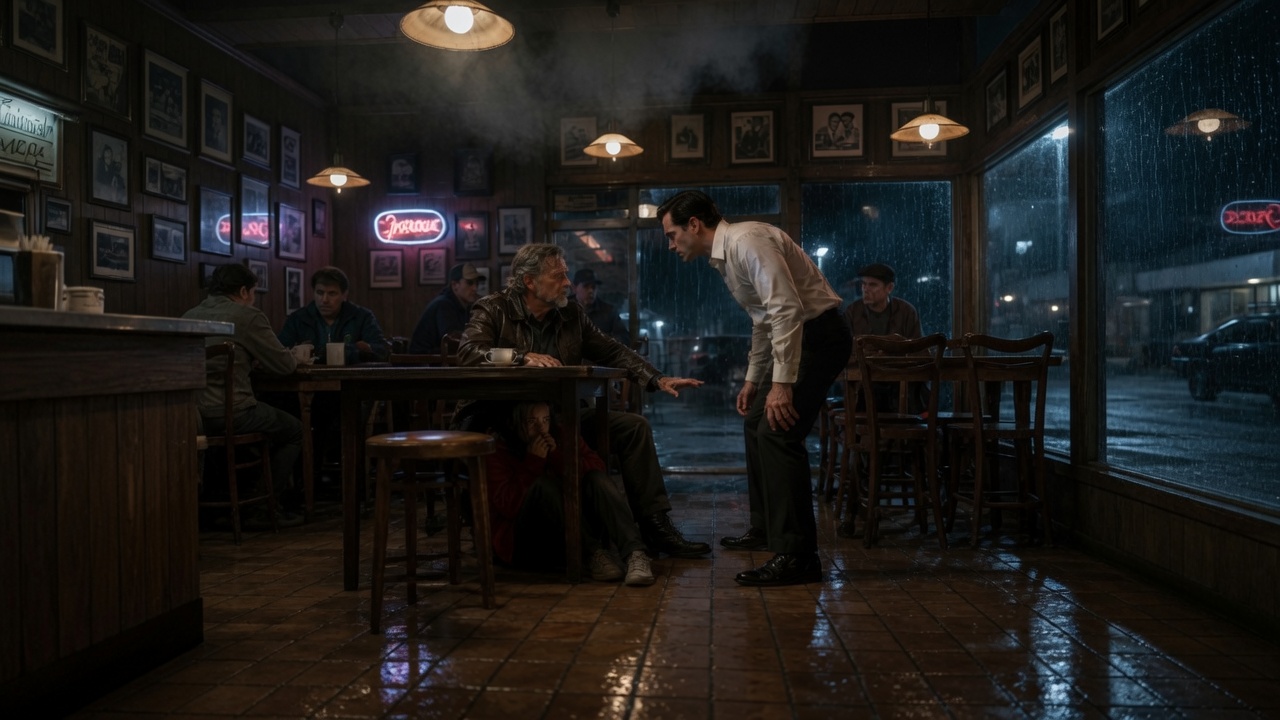
The little girl did not dare to breathe.
Curled beneath the corner table of a roadside bar, she pressed both hands over her mouth, trapping the terrified sounds that kept rising from her chest. Her red hoodie was streaked with dust, one sleeve torn almost to the elbow. Her knees were tucked so tightly against her body that they ached, but she did not move.
Not when rain hammered the windows.
Not when the old floorboards creaked above her.
Not even when the door slammed open so hard that every glass behind the bar trembled.
The conversations died first.
Then the music.

Then even the old radio seemed to lower its crackling voice, as if it, too, understood that something dangerous had entered the room.
The man in the white shirt stood just inside the doorway, shaking rainwater from his expensive coat. He looked wrong in a place like that. Too clean. Too polished. His shoes had never known mud. His hair was neatly combed, his smile gentle enough to fool anyone who had never seen a wolf pretending to be a house dog.
But the girl had seen him before.
She knew what lived behind that smile.
Behind the old man’s worn boots, she shrank deeper into the shadows.
The old man sat above her without moving. One weathered hand wrapped around a chipped coffee cup. His leather jacket was cracked at the shoulders, and his gray beard caught the red glow of the neon sign buzzing near the window. To anyone else, he looked like just another tired stranger waiting out the storm.
But the girl had run to him for a reason.
Because minutes earlier, she had burst through the bar door trembling so violently she could barely stand. Her lips had been blue from cold. Her eyes had searched every face in the room until they landed on the old man.
She had whispered only six words.
“Mom said find the silver bird.”
The old man had gone still.
Then, without asking anything else, he had shifted his chair, lifted the edge of the tablecloth, and said quietly, “Stay there. Don’t make a sound.”
Now the man in the white shirt took another step inside.
“A girl ran in here,” he said smoothly. “Small. Red hoodie. Has anyone seen her?”
No one answered.
The bartender froze with one hand around a glass. Two truck drivers near the counter stopped chewing. A woman in a denim jacket stared hard into her drink, her knuckles white around the bottle.
The old man finally lifted his eyes.
“Why would a little girl be running from you?”
The younger man’s jaw tightened.
For the shortest moment, his mask slipped.
Then he laughed softly, as if the question amused him. “She’s confused. Scared. She belongs with us.”
Under the table, the girl squeezed her eyes shut.
Belongs.
That word made her whole body tremble.
The old man heard it. He lowered one hand slowly beside the table, palm open, steady and calm.
A silent promise.
Don’t move.
I know you’re there.
I won’t let him take you.
The man in white noticed the gesture but not its meaning. His eyes swept the bar, measuring every face, every possible witness.
“This is family business,” he said, his voice colder now.
The old man set his coffee cup down.
The sound was small.
But in that silence, it felt like thunder.

“Not anymore.”
A chair scraped somewhere in the room.
The younger man’s polite smile disappeared.
He stepped closer to the old man’s table and leaned down, lowering his voice. “You don’t know what you’re getting involved in.”
The old man looked up at him.
His eyes were pale blue and tired.
But they were not afraid.
“I know enough.”
Then, from beneath the table, something slipped from the girl’s pocket.
A small folded photograph slid out, fluttered once, and landed face-up on the tiled floor.
The old man looked down.
And for the first time, his calm broke.
In the photo was a woman with tired eyes, a gentle smile, and a silver necklace shaped like a tiny bird.
The old man’s fingers tightened against the edge of the table until the skin went white.
His face drained of color.
Because he knew that woman.
He had known her laugh before grief took it away.
He had known the way she tucked her hair behind one ear when she lied.
He had known the tiny scar above her eyebrow from the bicycle accident she had at seven years old.
That woman was his daughter.
“Mara,” he breathed.
The man in white saw recognition flash across his face.
And for the first time, his confidence faltered.
“You,” he whispered.
The old man slowly picked up the photograph. His hands trembled now, not from age, but from something older and sharper.
For twelve years, Silas Reed had carried a question like a bullet lodged beneath his ribs.
Where had his daughter gone?
Mara Reed had disappeared at twenty-three, two weeks before she was supposed to testify against the Halden Foundation, a charity that claimed to rescue homeless women and children. Silas had been a deputy marshal then. He had begged her not to dig deeper. Mara had only smiled and touched the silver bird necklace around her throat.
“You taught me not to look away, Dad,” she had said.
Then she vanished.
Her apartment had been wiped clean. Her car had been found near a river. The police called it a tragic accident. Silas called it murder.
Everyone told him to let her go.
Instead, he spent twelve years hunting ghosts.
The man in white straightened, his face no longer pleasant.
“Give me the girl,” he said.
Silas looked at the photo again.
The woman in it was older than Mara had been when she vanished. Thinner. More tired. But alive.
Alive.
Under the table, the child made a tiny sound.
Silas lowered his voice. “What’s your name, sweetheart?”
For a moment, there was only the rain.
Then the answer came, so small it almost broke him.
“Lily.”
The name struck him like a second heartbeat.
That had been Mara’s favorite name.
The name she used to give every doll, every stray cat, every character in the stories she wrote as a child.
Silas closed his eyes.
When he opened them, the tired old stranger was gone.
Something else sat in his place.
Something that had waited twelve years to stand up.
“Lily,” he said softly, “is your mother Mara?”
The girl did not answer with words.
She began to cry.
The man in white snapped, “She doesn’t know what she’s saying.”
Silas rose from his chair.
He was not tall anymore, and age had bent his shoulders, but the room seemed to shift around him. The truck drivers turned slightly in their seats. The bartender put the glass down. The woman in denim quietly reached beneath the counter.
The man in white noticed.
His eyes narrowed.
“What is this place?”
Silas smiled without warmth.
“A bar.”
“No.” The younger man looked from face to face. “No, it isn’t.”
Silas stepped away from the table, keeping his body between the man and the child.
“You should have kept driving, Adrian.”
The man stiffened.
No one had said his name.
Not publicly.
Not in years.
Adrian Halden was supposed to be respectable now. A philanthropist. A donor. A man photographed beside mayors and judges, smiling with children whose names he never cared to learn.
But Silas remembered him differently.
He remembered a young lawyer standing beside the Halden Foundation’s director twelve years earlier, whispering to reporters that Mara Reed was unstable, dishonest, desperate for attention.
He remembered Adrian’s smile at the memorial service.
He remembered wanting to break every bone in that smiling face.
Adrian’s hand moved toward the inside of his coat.
The woman in denim spoke sharply.
“Don’t.”
A pistol was already in her hand, aimed low but steady.
Adrian froze.
The truck drivers stood next.
One blocked the front door.
The other moved toward the hallway that led to the back exit.
The bartender reached under the counter and pressed a button hidden beneath the cash register.
A red light blinked once beside the old radio.
Lily stared from under the table, confused through her tears.
Silas did not look away from Adrian.
“You always liked clean places,” Silas said. “Clean shirts. Clean stories. Clean records. That was your gift, wasn’t it? Taking filthy things and making them look respectable.”
Adrian’s eyes flashed. “You have no idea what you’re talking about.”
“I know my daughter was alive long after you told the world she was dead.”
Adrian swallowed.
That was enough.
Silas saw it.
So did everyone else.
The storm outside roared harder, shaking the windows.
“You think this helps you?” Adrian hissed. “An old drunk. A scared child. A roadside bar full of nobodies?”
The bartender finally spoke.
Her voice was quiet.
“We’re not nobodies.”
She turned the old radio slightly.
Static cleared.
A voice crackled through.
“Federal units are three minutes out.”
Adrian’s face changed completely.
Not anger now.
Fear.
Silas saw it and felt something inside him loosen for the first time in twelve years.
The bar was not an accident.
It had not been for a long time.
After Mara vanished, Silas had lost his badge, his marriage, his house, and almost his mind. But he had not lost his instincts. Piece by piece, survivor by survivor, he had discovered the truth. The Halden Foundation had never rescued the vulnerable.
It collected them.
Moved them.
Renamed them.
Buried them alive in clean paperwork.
And this ugly little roadside bar, forgotten between two dying towns, had become something else.
A safe house.
A place whispered about by women running in the night.
A place marked by a tiny silver bird carved beneath the third window.
A place Mara must have remembered.
Silas looked down toward the table.
“She sent you here,” he said.
Lily crawled out slowly, her red hoodie trembling around her small body. Her face was dirty, her cheeks wet, but around her neck hung a silver necklace shaped like a bird.
Silas’s breath caught.
It was not like Mara’s.
It was Mara’s.
“She gave me this,” Lily whispered. “She said if I got away, I had to find Grandpa Silas.”
The old man’s knees nearly failed him.
Grandpa.
The word entered him like light entering a room that had been locked for years.
Adrian lunged.
It happened fast.
Too fast for Lily to scream.
He grabbed her by the arm and dragged her toward him, twisting her small body against his chest like a shield.
Everyone froze.
His polished face was gone now. His mouth twisted. His eyes burned with panic.
“Back away,” he shouted. “All of you!”
Lily whimpered.
Silas did not move.
Not outwardly.
But his eyes shifted to the coffee cup on the table.
Adrian followed his glance too late.
The chipped cup was not a cup.
Not entirely.
Inside its cracked ceramic wall, a tiny camera had been recording since the moment Adrian walked in.
Every word.
Every threat.
Every confession in his face.
Adrian realized it.
His grip on Lily loosened for half a second.
That was all Silas needed.
He moved with a speed no one expected from a man his age. His hand struck Adrian’s wrist. The woman in denim surged forward. The truck driver caught Lily and pulled her away as Adrian crashed into the table, sending the coffee cup spinning across the floor.
Lily screamed once.
Then Silas had her in his arms.
He held her so tightly she could feel his heart pounding.
Outside, sirens tore through the rain.
Adrian struggled, but three people pinned him down before he could reach the door. The bartender came around the counter holding zip ties. The woman in denim kept her weapon trained on him until blue and red lights splashed across the windows.
Federal agents flooded the bar.
Orders shouted.
Boots thundered.
Adrian Halden, the spotless man in the white shirt, was dragged upright with his wrists bound behind his back.
His eyes found Silas.
“You don’t understand,” he spat. “If I go down, she goes down too.”
Silas froze.
The agents around them exchanged glances.
Lily lifted her tear-soaked face from Silas’s jacket.
“What does he mean?”
Adrian smiled again.
A broken, vicious smile.
“Your mother didn’t escape me,” he whispered. “She worked for me.”
The room went silent.
Lily shook her head. “No.”
Silas felt the old bullet in his chest twist deeper.
Adrian laughed softly. “Ask him. Ask your heroic grandfather why Mara stayed alive so long. Ask him why she sent little girls down highways with secret necklaces and old photographs. Ask him what kind of mother uses her own child as bait.”
Silas looked down at Lily.
Her eyes were huge.
Waiting.
Breaking.
Then a voice came from the doorway.
“She used herself.”
Everyone turned.
A woman stood in the rain behind the federal agents, wrapped in a dark coat, her hair cut short, her face pale beneath the flashing lights.
Older.
Thinner.
Haunted.
But alive.
The silver bird necklace was gone from her neck.
Because Lily was wearing it.
Silas could not breathe.
“Mara,” he whispered.
His daughter stepped into the bar.
For a moment, she looked twenty-three again. Standing in his kitchen. Touching that necklace. Saying, You taught me not to look away, Dad.
Then Lily tore from his arms.
“Mom!”
Mara dropped to her knees just as the child collided with her. She wrapped both arms around Lily and buried her face in her daughter’s hood, sobbing so hard her whole body shook.
“I’m sorry,” she cried. “I’m so sorry, baby. I had to make him follow you. I had to make him say it where they could hear. I was right behind you the whole time.”
Silas stared at her.
“You were alive.”
Mara looked up at him, tears streaming down her face.
“I wanted to come home.”
“Why didn’t you?”
Her answer was barely audible.
“Because I was the only witness they couldn’t afford to kill.”
Silas understood then.
The real twist was not that Mara had survived.
It was what she had become.
Not a prisoner.
Not a traitor.
Not a ghost.
She had spent twelve years inside the monster’s house, memorizing names, routes, accounts, judges, donors, every locked door and every buried child.
And tonight, she had finally brought the whole empire down.
Adrian screamed her name as agents shoved him toward the exit, but Mara did not look at him.
She looked only at her father.
“I kept Lily hidden as long as I could,” she said. “But when Adrian found out about her, I knew there was only one place left.”
Silas looked around the bar.
At the truck drivers who had once been smugglers before becoming informants.
At the bartender who had lost a sister to Halden.
At the woman in denim, a federal agent who had waited six months for this exact night.
Then he looked at the little silver bird carved beneath the window.
Mara had not run from him.
She had run toward him.
Through twelve years of darkness, his daughter had followed the trail he built from grief.
Silas stepped forward slowly.
Mara rose with Lily in her arms.
For a heartbeat, father and daughter only stared at each other, separated by every year they had lost.
Then Mara whispered, “I’m home, Dad.”
Silas broke.
He pulled them both into his arms.
Outside, the rain kept falling, washing the dirt from the road, the blood from old memories, the lies from clean white shirts.
And when the first pale light of morning touched the windows of the roadside bar, Lily was asleep against her grandfather’s chest, one hand curled around the silver bird necklace.
Silas looked at Mara.
For the first time in twelve years, he did not ask where she had been.
He did not ask what she had suffered.
He simply held his daughter’s hand and listened as the sirens faded into dawn.
Because some miracles did not arrive clean.
Some came running through rain.
Some hid beneath tables.
And some wore red hoodies, carried old photographs, and whispered six words strong enough to resurrect the dead.
Mom said find the silver bird.
Leave a Reply