
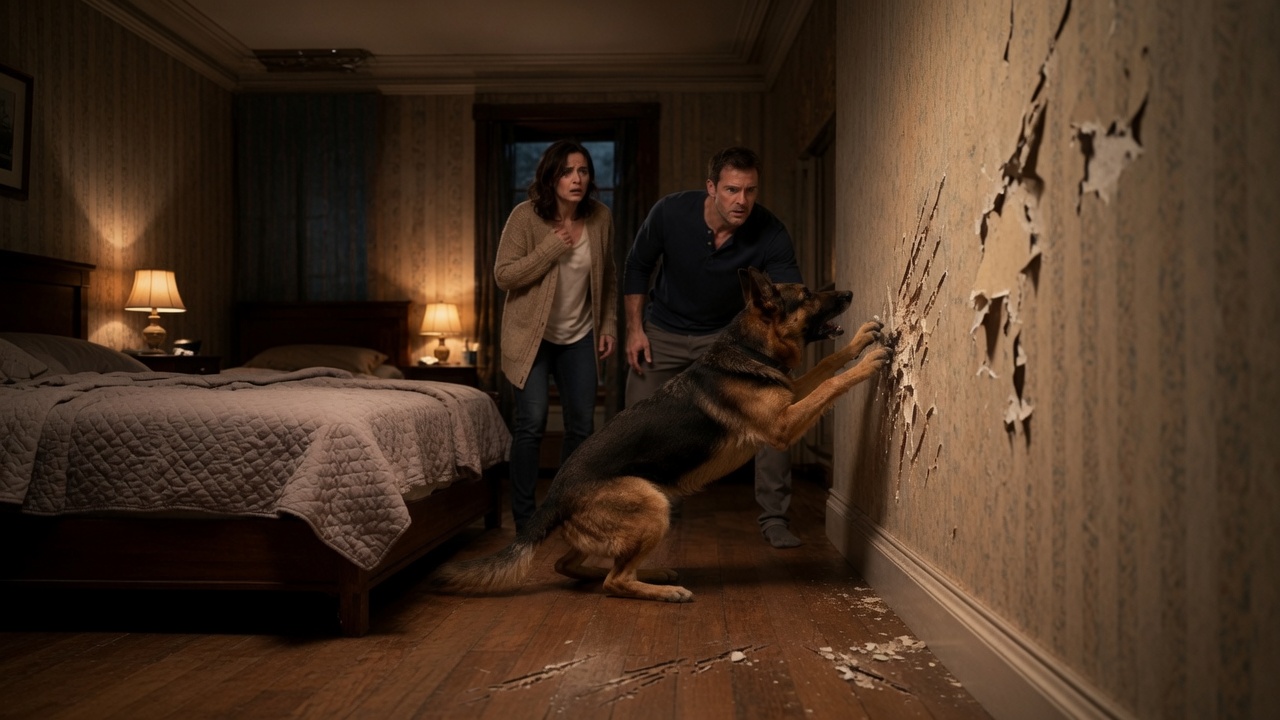
The first warning came from the dog.
Not from a creaking floorboard. Not from a strange shadow in the hallway. Not from the old pipes groaning at night.
It came from Rada, our German Shepherd, standing frozen in our bedroom with her ears stiff, her body tense, and her eyes locked on one blank wall as if someone invisible were staring back at her.
When Daniel and I bought the house on Briar Lane, we thought we were stepping into the happiest chapter of our lives. It was not new. The roof sagged slightly over the porch. The wallpaper had faded into a soft yellow. The wooden floors complained beneath every step. But to us, it felt warm, safe, and full of promise.
Our six-year-old daughter, Lily, fell in love with her room the second she saw it.
“It has princess windows,” she whispered, spinning beneath the pale curtains.
Daniel laughed and lifted her into his arms. “Then this is your castle.”
I remember standing in the doorway, watching them, thinking we had finally found where we belonged.

Rada moved in with us too.
At first, she behaved normally. She sniffed every corner, chased leaves in the yard, slept beside Lily’s bed, and followed me from room to room while I unpacked boxes. She ate well. Played well. Guarded us with the gentle seriousness that had made us love her from the first day we adopted her.
Then, one week after we moved in, everything changed.
At 2:13 in the morning, Rada began barking.
I woke so suddenly that my chest hurt. Daniel shot upright beside me and switched on the lamp. Rada was standing at the side of our bed, not looking at the door, not looking at the window, but staring directly at the wall beside my pillow.
“Rada,” Daniel whispered. “Girl, what is it?”
She did not turn.
Her hackles were raised. Her ears were sharp. A deep growl trembled in her throat, low and terrible, like something had reached through the darkness and touched her.
I pressed a hand to my heart. “Maybe there’s a mouse.”
Daniel tapped the wall, listened, frowned, then shook his head. “Nothing.”
He led Rada out of the room and gave her water. Eventually, she settled down.
But the next night, it happened again.
Then the night after that.
And the night after that.
Always at 2:13. Always the same wall. Always the same look in her eyes.
During the day, she was perfect. She played with Lily in the yard. She slept in patches of sunlight. She rested her head on my knee while I worked at the kitchen table. But when night fell, she became a different dog.
A watcher.
A guard.
A warning.
After three weeks, Daniel and I were exhausted. We called pest control. The man inspected the house, attic, basement, crawl spaces, and walls. He found no rodents, no nests, no insects, no animal droppings.
“This house is clean,” he said. “Old houses make noise. Dogs hear things we don’t.”
But Rada was not hearing an old house.
She was hearing something behind that wall.
The proof came on a rainy Thursday evening.
We were watching a movie after putting Lily to bed when Rada suddenly lifted her head. Her ears went stiff. Then she sprang up so fast the coffee table shook.
“Rada?” I called.
She bolted down the hallway.
Seconds later, her barking exploded from our bedroom.
Daniel and I ran after her. When we reached the door, we froze.
Rada was clawing at the wall.
Not scratching.
Not playing.
Digging.
Her paws tore at the wallpaper. Her nails scraped white scars into the paint. She barked, backed up, lunged again, and slammed her body against the wall with desperate force.
“Stop!” Daniel shouted, grabbing her collar.
Rada twisted away from him and barked louder, staring at us as if we were the foolish ones, as if she had been screaming the truth for a month and we had refused to listen.
Daniel stood there breathing hard. His face had gone pale.
Then he whispered, “Maybe something really is there.”
The next morning, we called a contractor.
His name was Mason Vale, a broad-shouldered man with gray in his beard and a polite smile that told me he thought we were being dramatic. He carried a toolbox into our bedroom while Rada watched him from the doorway, silent but trembling.
“Dogs can be strange after moves,” Mason said.
“Just check,” Daniel replied.
Mason tapped the wall with his hammer.
Once.
Twice.
On the third tap, his smile disappeared.
He tapped again, slower.
The sound changed.
Hollow.
The room went silent.
Mason leaned closer, his forehead creasing. “That’s odd.”
My mouth went dry. “Odd how?”
“There shouldn’t be this much space behind here.”
Daniel reached for my hand.
Mason cut a neat square into the drywall. White dust floated in the air. He pulled away the first piece, then another. At first, all we saw was darkness.
Then the smell hit us.
Stale air.
Old paper.
Damp wood.
Something metallic and sour.
Mason shone his flashlight inside and swore under his breath.
Behind our bedroom wall was not a pipe gap or insulation.
It was a hidden opening.
A narrow passage stretched into the dark, just wide enough for a person to crawl through.
Rada pushed past Daniel and barked once into the hole.
Then, from somewhere deep inside the wall, something answered.
A soft, electronic beep.
My blood turned cold.
Mason stepped back. “Call the police.”
Within twenty minutes, our bedroom was full of officers. Lily sat at the kitchen table with Daniel’s sister, unaware of what was happening. I stood in the hallway, arms wrapped around myself, listening as flashlights clicked and voices murmured.
One officer crawled into the passage.
Another followed.
Then came the words that changed my life.
“There’s a room back here.”
A hidden room.
Not large. Not finished. Bare wooden beams. Dusty floor. Old wiring. A narrow vent that opened behind the closet. And inside that room were things no wall should ever hold.
A sleeping bag.
Empty water bottles.
A cracked phone charger.
A tiny camera connected to a wire that ran through a hole no wider than a nail.
The camera had been pointing into our bedroom.
I staggered backward.
Daniel caught me. “Mia.”
I couldn’t breathe. Someone had been watching us. Sleeping feet away from us. Moving through our walls while our daughter slept down the hall.
Then an officer came out holding a plastic evidence bag.
Inside was a pink hair ribbon.
Lily’s ribbon.
The one she had lost two nights earlier.
I screamed.
Daniel ran to the kitchen, grabbed Lily, and held her so tightly she began to cry.
That was when Rada pushed into the bedroom again. She did not bark this time. She walked to the hole, lowered her nose, and whined.
A broken, grieving sound.
One of the officers crawled deeper into the passage. Moments later, he called out, “There’s another box.”
They brought it out carefully.
It was an old metal lunchbox, rusted at the edges, painted with faded blue flowers. Across the top, written in black marker, were three words:
FOR MY DAUGHTER.
No one spoke.
The detective, a woman named Harris, opened it with gloved hands.
Inside were photographs, newspaper clippings, cassette tapes, and a small silver bracelet.
My knees weakened when I saw the bracelet.
It had a name engraved on it.
MARA.
I heard Daniel ask, “Mia? What is it?”
But I could not answer.
Because I had seen that bracelet before.
Not in real life.
In a dream.
A dream I had carried since childhood. A woman crying. A dog barking. A wall closing. A silver bracelet falling from a tiny wrist.
Detective Harris lifted one of the photographs.
It showed a young woman standing on the porch of our house, holding a little girl with dark hair and wide eyes.
The woman was beautiful, but frightened.
The girl was maybe three years old.
On the child’s left cheek, just below the eye, was a tiny crescent-shaped birthmark.
My fingers rose to my own face.
To the birthmark I had covered with makeup every day since high school.
Daniel whispered, “That’s impossible.”
Detective Harris looked at me sharply. “Do you know this child?”
The hallway tilted.
I gripped the wall to keep from falling.
“No,” I said, but my voice sounded far away. “I don’t know.”
But something inside me did.
The police searched public records that night. The house had belonged to a man named Arthur Bell. His wife, Clara, disappeared twenty-nine years earlier. Their three-year-old daughter, Mara, vanished the same week.
Arthur told police Clara had run away with the child.
The case went cold.
Arthur sold the house years later, moved to another town, and died alone.
No one ever found Clara.
No one ever found Mara.
Until Rada barked at our wall.
Detective Harris played one of the cassette tapes in our kitchen while I sat shaking at the table.
The voice that filled the room was soft, trembling, and unmistakably a mother’s.
“If anyone finds this, my name is Clara Bell. My husband is not the man people think he is. He built the space behind the walls to watch me. To punish me. To make sure I could never leave without him knowing.”
Static hissed.
Daniel held my hand.
Clara continued.
“He thinks I don’t know about the passage. But I do. I have hidden proof here. If I disappear, please find my daughter. Please find Mara. She has a crescent mark under her left eye. She is brave. She loves music. She calls our dog Radley ‘Rada’ because she cannot say his name.”
My heart stopped.
Rada.
Our Rada.
The shelter had told us she was a rescue from an abandoned breeding property. No history. No owner. No explanation for why she refused to respond to any name except Rada.
But Rada could not be twenty-nine years old.
Detective Harris found the answer in another photograph.
It showed Clara’s German Shepherd, Radley, standing beside a litter of puppies. On the back, Clara had written:
Radley’s last litter. I kept the smallest girl. Mara calls her Rada too.
Rada was not the same dog.
She was the bloodline.
The last living echo of the dog that had tried to save me.
By sunrise, the police had pieced together the truth. Arthur had killed Clara when she tried to leave. He had hidden evidence in the wall, never realizing Clara had already hidden her own. Three-year-old Mara had escaped the house that night through the passage, wandered into the street, and was later found miles away, too traumatized to say her name.
I was adopted six months later.
My adoptive parents had told me I was found abandoned outside a church.
They had never known the rest.
I sat on the floor of my bedroom, staring at the hole in the wall that had stolen my past and returned it in the same breath.
Daniel knelt beside me. “Mia,” he said softly. “Or… Mara.”
I looked at him through tears. “I don’t know who I am.”
Rada came to me then.
She pressed her warm body against mine, rested her head in my lap, and sighed as if she had finally completed a task given to her before she was even born.
And then, from inside the hidden room, an officer called out one last time.
“We found another message.”
It was written on the wooden beam in faded pencil, low to the floor, where only a child hiding in the dark might see it.
The letters were uneven.
A mother’s final words.
Mara, if you come back, don’t be afraid of the wall. I am behind it, loving you.
For the first time since moving into that house, I understood why it had felt familiar.
It had never been our new beginning.
It had been the place where my first life ended.
And because one dog refused to stop barking, it became the place where the truth finally came home.
The police found Clara’s remains beneath the old garden shed two days later.
We buried her under a maple tree in the cemetery at the edge of town. I placed the silver bracelet on her grave, then took it back before we left. Daniel said nothing. He understood.
Some things are not meant to stay with the dead.
Some things are returned to the living.
We moved out of the house before the month ended. I could not sleep there again. Lily cried when we packed her princess curtains, but Rada stayed calm, as if she knew the house no longer needed guarding.
On our final morning, I stood in the empty bedroom and looked at the repaired wall.
For a moment, the room was silent.
Then Rada walked to the same spot, sat down, and gently pressed her nose against it.
Not barking.
Not warning.
Saying goodbye.
I knelt beside her and touched the wall too.
“Thank you,” I whispered.
I meant Clara.
I meant Rada.
I meant the frightened little girl who had once crawled out of darkness and survived long enough to come back as a woman.
As we drove away, Lily leaned over the back seat and asked, “Mommy, was that house bad?”
I looked at Daniel, then at Rada, sitting tall beside our daughter with sunlight glowing around her ears.
“No, sweetheart,” I said.
My voice broke, but I smiled.
“That house was hurt.”
Lily thought about that for a moment. Then she reached over and hugged Rada’s neck.
And Rada, who had barked at nightmares, walls, ghosts, secrets, and the buried bones of my past, simply closed her eyes.
At last, she rested.
At last, we all did.
Leave a Reply