
The trouble did not begin in the sky.
It began before the plane had even moved, in that strange, suffocating silence that settles over a crowded cabin when too many strangers are trapped too close together—and one cruel sentence suddenly makes everyone forget how to breathe.
Flight 728 was nearly ready for takeoff.
Passengers were already buckled in, pretending not to notice one another. A businessman tapped impatiently on his phone. A college student pressed headphones over his ears. An elderly woman clutched a paperback novel without turning a page. Overhead, flight attendants closed bins with soft clicks, smiling the tired smiles of people who had already solved twenty problems before sunrise.
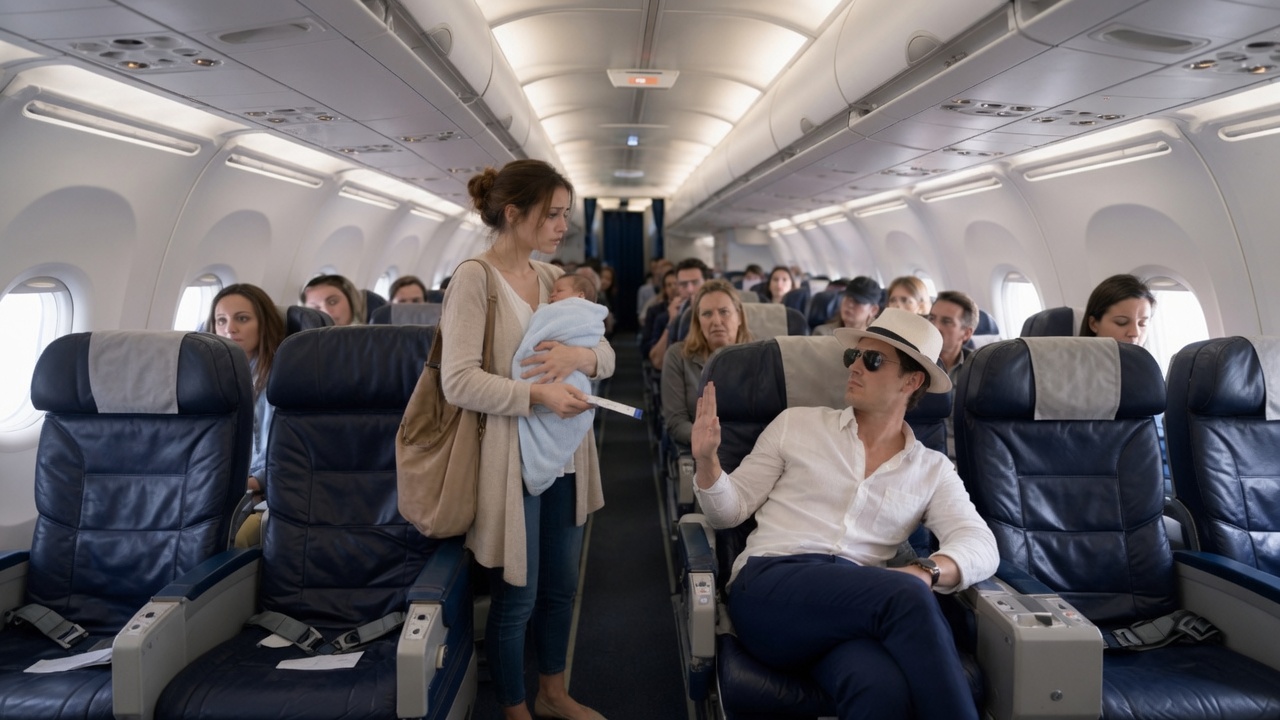
Then a young woman stepped into the cabin with a baby in her arms.
She could not have been more than twenty-eight. Her brown hair was tied in a loose bun, but several strands had escaped and stuck to her tired face. Her beige cardigan hung crookedly from one shoulder beneath the weight of a tan bag. In her arms, wrapped in a pale blue blanket, a tiny baby slept with one cheek pressed against her chest.
She looked as if she had not slept properly in weeks.
“Sorry,” she whispered, squeezing down the aisle. “Excuse me. Thank you. Sorry.”
Her voice was gentle, almost apologetic, as if even taking up space was something she felt guilty for.
Some passengers gave her sympathetic smiles. Others immediately lowered their eyes, silently praying she would not stop beside them. The baby remained quiet, his little mouth slightly open, breathing softly against her blouse.
At last, the young mother reached her row.
Her boarding pass said seat 12C—an aisle seat.
But the man in 12B was already sprawled across his space as if the airplane belonged to him.
He was young, perhaps twenty-six or twenty-seven, with a sharp jaw, expensive watch, white linen shirt, navy trousers, dark sunglasses, and a white Panama hat tilted back on his head. He looked like the kind of man who had never been told no without immediately asking for someone’s manager.
The woman gave him a polite, exhausted smile and began lowering her bag.
That was when he saw the baby.
His head snapped toward her.
“Don’t sit here,” he said.
The woman froze. “I’m sorry?”
“This isn’t your seat.”
She blinked, confused, then shifted the baby carefully against one arm and pulled out her boarding pass.
“No,” she said softly, showing him the ticket. “This is my seat.”
He did not even look.
“I don’t want you sitting next to me.”
The words landed like a slap.
A few heads turned. The flight attendant at the front paused with her hand still on an overhead bin.
The young mother’s face flushed. “Why?”
“Because that child is going to cry the entire flight,” he said coldly. “And I don’t have the patience or the nerves to deal with it.”
The baby was sleeping peacefully.
The woman swallowed. “He’s calm right now. And there are no other seats.”
The man laughed through his nose. “That’s what mothers always say. Your children are always angels. Meanwhile, everyone else has to suffer.”
A murmur spread through the cabin.
The mother hugged the baby closer. “If he cries, I’ll calm him down. You can use headphones if—”
“I’m not using anything,” he snapped. “You need to move.”
“There is nowhere for me to move.”
“Then that’s your problem.” He leaned back and crossed one leg over the other. “Maybe people with babies shouldn’t fly.”

The entire cabin went silent.
It was not the normal quiet of travelers waiting for takeoff. It was heavier than that. Hotter. Meaner. The kind of quiet that forms when everyone knows something wrong has happened, but no one wants to be the first to stand up.
The young mother lowered her eyes.
For one heartbreaking second, she looked completely alone.
Her fingers tightened around the strap of her bag. She shifted the baby higher against her chest and took a small step backward, as if she might turn around and leave the plane entirely because she simply did not know what else to do.
Then a voice from the front of the cabin rang out.
“Wait.”
The word was not loud, but it carried through the plane like thunder.
Everyone turned.
An elderly man stood just beyond the curtain separating first class from economy. He was tall but slightly bent with age, dressed in a dark suit, one hand gripping a polished cane. His silver hair was combed neatly back, and his face carried the calm authority of someone accustomed to being obeyed without raising his voice.
The rude young man stiffened.
Behind his sunglasses, his face changed.
“Dad?” he said.
A wave of whispers moved through the cabin.
The old man’s eyes did not soften.
“Marcus,” he said, “take off your sunglasses.”
The young man hesitated.
“Now.”
Marcus removed them slowly. Without the glasses, he looked less powerful and more like a spoiled boy caught stealing.
The young mother stared between them, confused and trembling.
The old man walked down the aisle. Every passenger watched him pass. Even the flight attendants stepped aside.
When he reached row twelve, he looked first at the mother, then at the baby, then at Marcus.
“I heard everything,” he said.
Marcus forced a thin laugh. “Dad, this is being blown out of proportion. I just asked for another seat. I have an important meeting after we land, and I don’t want to spend three hours listening to—”
“To what?” the old man interrupted. “A baby breathing?”
Marcus’s jaw tightened.
The old man turned to the young mother. “Anna, I am so sorry.”
The woman’s eyes widened.
“You know my name?” she whispered.
The old man’s expression changed then. Not anger. Not embarrassment. Something deeper. Something full of grief.
“I do,” he said. “I have wanted to meet you for a long time.”
Marcus frowned. “What are you talking about?”
The old man looked at him.
And when he spoke again, his words cut through the cabin like a blade.
“Marcus, this woman is Anna Vale.”
The young man stared. “Vale?”
“Yes,” his father said quietly. “Your brother’s wife.”
A gasp rippled through the passengers.
Marcus went pale.
The young mother’s lips parted, but no sound came out. The baby stirred in her arms, then settled again, unaware that the entire world around him had just shifted.
Marcus shook his head. “No. That’s not possible. Daniel wasn’t married.”
“He was,” the old man said. “Quietly. Without my blessing, because I was foolish enough to believe money gave me the right to decide who my son loved.”
Anna’s eyes filled with tears.
The old man looked at the baby wrapped in blue.
“And that child,” he said, voice breaking for the first time, “is your nephew.”
The plane seemed to disappear.
Marcus stared at the baby as if seeing him for the first time—not as noise, not as inconvenience, not as a problem wrapped in a blanket, but as blood.
His blood.
Anna held the child tighter, her face pale with shock.
The old man continued, his voice steady again. “Daniel died before he could bring them home. Before he could ask me to forgive him. Before I could tell him I already had.”
A woman across the aisle covered her mouth.
The flight attendant’s eyes shone with tears.
Marcus swallowed hard. “Dad, I didn’t know.”
“No,” his father said. “You didn’t. But you didn’t need to know who she was to treat her like a human being.”
Those words struck harder than any shout could have.
Marcus looked around and suddenly realized everyone was watching him—not with admiration, not with envy, not with the respect he had always assumed his family name purchased, but with disgust.
His father reached into his suit jacket and took out a folded letter.
“Daniel wrote this before he died,” he said. “It arrived at my office two days ago with Anna’s contact information and a photograph of the baby. He asked me to take care of them if anything ever happened to him.”
Anna’s tears slipped down her cheeks.
“I didn’t know he wrote to you,” she whispered.
The old man nodded painfully. “He did. And I booked this flight for all of us because I wanted to bring my family together before the board meeting tomorrow.”
Marcus looked up sharply. “The board meeting?”
His father’s face hardened.
“Yes. The meeting where I was supposed to announce whether you would take my place as head of Vale Airways.”
Marcus’s mouth opened, then closed.
The passengers were now completely silent.
The old man pointed gently to the empty aisle seat beside Marcus.
“I gave Anna that seat because I wanted you to meet your brother’s family as a man, not as an heir. I wanted to see whether you had learned humility, patience, and compassion.”
His eyes locked on Marcus.
“Now I have my answer.”
Marcus stood halfway, panic flashing across his face. “Dad, please. I made a mistake. I was tired. I didn’t mean—”
“You meant every word when you thought she was nobody.”
That sentence broke him.
For the first time, Marcus had nothing clever to say.
The old man turned to Anna. “Please sit down. This is your seat. You and the baby are not moving.”
Anna hesitated, wiping her cheek with the back of her hand. “I don’t want to cause trouble.”
“You didn’t,” he said. “He did.”
Slowly, she sat in the aisle seat.
Marcus shrank beside the window, his white Panama hat now looking ridiculous in his lap. The baby slept between them in Anna’s arms, peaceful as a small moon.
The flight attendants finished their checks. The plane taxied. The engines roared.
For the first time in his life, Marcus Vale sat beside someone he could not buy, dismiss, or escape.
For the first hour, he said nothing.
Anna said nothing either.
She fed the baby from a small bottle, wiped his chin, kissed his forehead, and rocked him gently whenever the plane trembled. Not once did the child scream. Not once did he disturb anyone. The only restless person in row twelve was Marcus.
Eventually, he whispered, “What’s his name?”
Anna did not look at him. “Samuel.”
Marcus closed his eyes.
Daniel had always said that if he had a son, he would name him Samuel after their grandfather.
A memory struck him then—Daniel laughing in the garden, tossing a baseball in the air, saying, “If I ever have a kid, promise me you won’t teach him to be arrogant like us.”
Marcus had laughed at the time.
Now the memory felt like a punishment.
“I’m sorry,” he said.
Anna continued rocking Samuel. “For what?”
“For what I said.”
She finally looked at him. Her eyes were tired, but there was no hatred in them. Somehow that made him feel worse.
“You didn’t just insult me,” she said softly. “You showed me what kind of family my son might be walking into.”
Marcus flinched.
Outside the window, clouds rolled beneath them like an endless white sea.
The flight felt longer than three hours.
When they landed, no one rushed to stand. People watched quietly as the plane rolled to the gate. The old man waited at the front, leaning on his cane.
Marcus stood as soon as the seatbelt sign switched off.
“Anna,” he said, voice shaking. “Please. Let me carry your bag.”
She studied him for a moment.
Then she handed him the tan shoulder bag.
It was heavier than he expected.
As they walked up the aisle, passengers parted for them. Some smiled gently at Anna. One elderly woman touched her arm and whispered, “You were very brave.”
At the front, Marcus’s father waited.
But he was not alone.
Two men in suits stood beside him, each holding a leather folder. Marcus recognized them immediately: the family attorneys.
His stomach dropped.
“Dad,” Marcus whispered. “Please don’t do this here.”
The old man looked at him sadly.
“I am not punishing you in public, Marcus. You punished yourself in public.”
One attorney opened a folder.
The old man turned to Anna. “Daniel’s son is a Vale. And he will never have to beg for his place in this family.”
Anna shook her head, overwhelmed. “I didn’t come for money.”
“I know,” he said. “That is one reason Daniel loved you.”
Then he looked at Marcus.
“Tomorrow’s announcement is changed. The controlling shares I intended to place under your leadership will go into trust for Samuel until he is of age. Anna will sit on the family board as his guardian.”
Marcus staggered back as if the plane had lurched.
“No,” he breathed.
“Yes,” his father said. “You will keep your name. You will keep enough to live. But you will start at the bottom of the company if you want to stay in it. Customer service. Gate complaints. Lost luggage. Delayed flights. Crying babies. Real people.”
A few passengers exchanged stunned looks.
Marcus stared at Anna, then at Samuel, then at the floor.
Everything he had thought was his—the office, the title, the power, the family crown—had slipped away because of one moment when he thought kindness was optional.
Anna stepped forward, her baby sleeping against her heart.
For a moment, Marcus thought she might defend him.
Instead, she looked at the old man and asked quietly, “Will Samuel know about his father?”
The old man’s eyes filled with tears.
“Every day,” he said.
Marcus swallowed hard. “Anna…”
She turned to him.
His voice broke. “Will he know about me?”
Anna looked down at her baby, then back at Marcus.
“That depends,” she said. “On who you become after today.”
The words were gentle.
But they were also a sentence.
Months later, passengers from Flight 728 would still tell the story of the arrogant man in the white Panama hat who refused to sit beside a mother and baby.
Some remembered the public humiliation.
Some remembered the shocking family secret.
Some remembered the old man’s trembling voice.
But Marcus remembered something else most clearly.
He remembered the weight of Anna’s bag in his hand.
He remembered how small Samuel had looked in that blue blanket.
And he remembered the most painful truth of all:
He had not lost an inheritance because he was rude to someone important.
He had lost it because, for one unforgivable moment, he believed someone had to be important before they deserved kindness.
Leave a Reply