
They Sold the Dying Horse for Ten Dollars. By Sunset, the Men Who Laughed Were Begging the Old Man to Speak.
The first laugh came before the old man even raised his hand.
It rolled across the auction yard like thunder over dry fields, cruel and easy, the kind of laughter men use when they believe another creature’s suffering has nothing to do with them.
The old white horse lay in the dust beneath the burning morning sun, ribs pressing against its dirty coat, legs folded awkwardly under its trembling body. Its mane was tangled with mud. Old scars ran along its sides like faded rope marks. Every breath it took seemed to drag pain from the bottom of its chest.
Behind the wooden auction table, Roberto, the auctioneer, tapped his gavel with a lazy smile.
“Starting bid,” he called, his voice sharp enough to cut through the crowd, “ten dollars! Do I have any takers?”
The farmers laughed harder.
“That thing belongs in the slaughterhouse!”
“It’ll be dead before next week!”
“Nobody would take it even if it were free!”
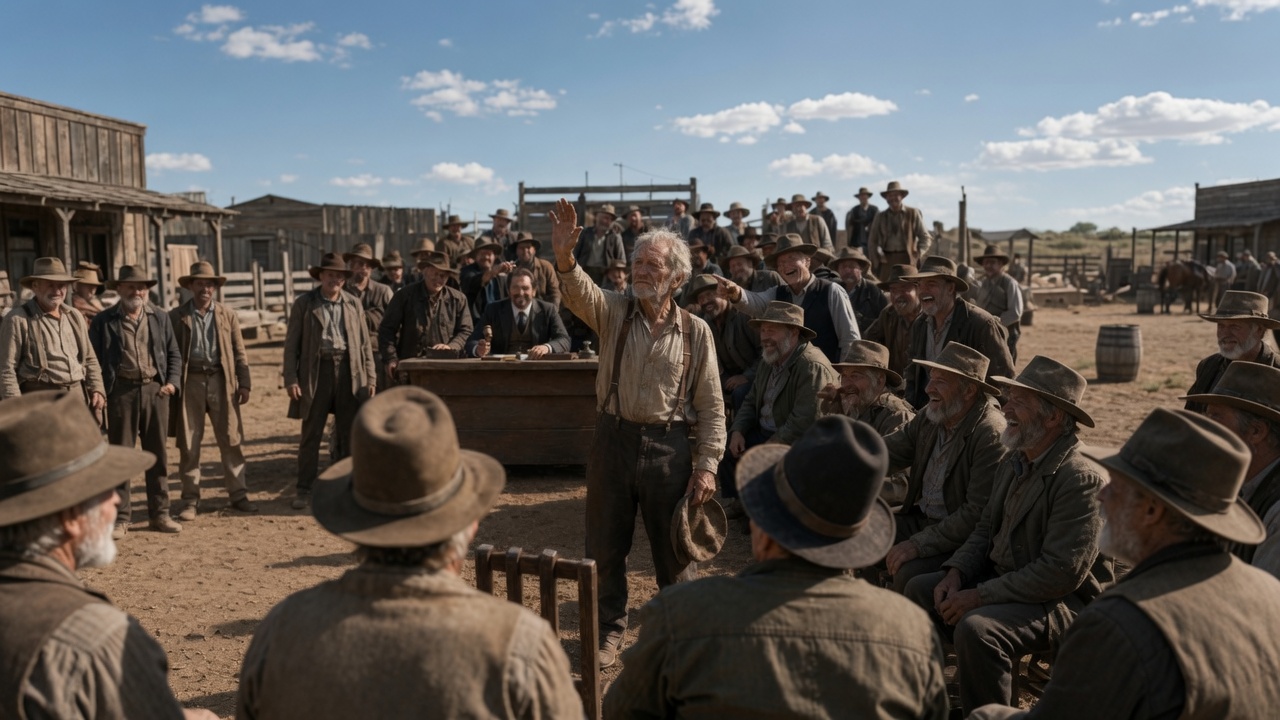
The country auction yard had been loud since sunrise. Men in dusty hats crowded around the wooden fences. Traders argued over cows, mules, harnesses, and grain carts. Some had come to buy. Others had come to boast. And some, as always, had come simply to watch another poor soul make a mistake.
But now all eyes were fixed on the collapsed horse.
No one saw anything worth saving.
No one, except the old man in the very last row.
He was thin, almost swallowed by his faded beige shirt and old brown suspenders. His boots were split at the sides, and his gray hair stuck out from beneath a worn cloth cap. His face was lined deeply, not only by age, but by years of hunger, loss, and disappointment.
Slowly, with a hand that shook, he stood.
The laughter softened into curious silence.
Then he raised his hand.

“I…” His voice cracked. “I’ll buy him.”
For half a second, nobody reacted.
Then the whole yard erupted.
A wealthy farmer named Calder Benton slapped his thigh and bent forward, roaring with laughter.
“Old man, have you completely lost your mind? That’s not a horse. That’s a pile of bones!”
Another shouted, “You’re about to throw away your last bit of money! In a few days, that poor thing will die, and you’ll have nothing left to eat!”
“You’d be better off buying bread!”
The old man did not look at them. He walked slowly toward the auction table, each step heavy in the dust. When he reached Roberto, he reached into his pocket and pulled out a small bundle of wrinkled bills and coins.
He placed them on the wood carefully.
“This is everything I have left.”
The crowd murmured.
“He’s crazy.”
“Now he’ll starve too.”
Roberto’s smirk faded slightly. He looked down at the money, then back at the old man.
“Are you sure?” he asked. “Nobody is giving your money back.”
“I’m sure.”
Roberto leaned back. “Why do you want this horse?”
The old man turned toward the dying animal. His tired eyes softened with something deeper than pity.
“Because,” he said quietly, “he’s my last hope.”
For a moment, even the flies seemed to stop buzzing.
Then someone laughed again.
“Hope? In that half-dead wreck?”
“He won’t even make it home!”
The old man ignored them. He crossed the ring, knelt beside the horse, and gently placed one trembling hand on its filthy neck.
The horse’s body shuddered.
A farmer snorted. “Careful, old man. It might die from kindness.”
But the old man bowed his head close to the horse’s ear and whispered something no one else could hear.
The horse’s ear twitched.
Roberto stopped smiling.
The old man whispered again, softer this time.
The horse opened one eye.
The laughter thinned.
Then, with a sound like a broken bellows, the horse lifted its head and pressed its muzzle weakly against the old man’s chest.
The entire auction yard fell silent.
Calder Benton’s face changed first. His smile vanished. His thick fingers curled against the railing.
Roberto stood so quickly his chair scraped backward.
“What did you say to it?” he demanded.
The old man did not answer.
He stroked the horse’s neck, his own eyes filling with tears. “Easy,” he whispered. “Easy, Silver. I found you.”
At the name, the horse tried to rise.
A gasp moved through the yard.
The animal pushed one shaking leg under itself, then another. Its body trembled terribly, but somehow, impossibly, it lifted its chest from the dirt.
“Impossible,” someone breathed.
The old man turned sharply. “Water,” he said. “And molasses, if anyone has it. Salt too.”
No one moved at first.
Then a woman near the fence rushed away. A young boy grabbed a bucket. Another man ran toward the feed shed.
Roberto slammed his gavel down. “This sale is finished! The old man has made his foolish purchase. Move along!”
But no one moved along.
Everyone was watching the horse.
The boy returned with water. The old man held the bucket near the animal’s mouth, letting it drink slowly.
“Not too much,” he murmured. “Slowly, Silver. Slowly.”
Calder pushed through the crowd. “You keep calling it that. Why?”
The old man looked up at him, and something cold passed through his eyes.
“Because that is his name.”
Calder laughed once, but it sounded forced. “Plenty of white horses are called Silver.”
“Not this one.”
Roberto’s hand tightened around the gavel. “Old man, take your animal and leave.”
The old man ignored him and gently parted the horse’s tangled mane. His fingers searched beneath dried mud and knots of hair until they found something hidden near the base of the neck.
A scar.
Not an ordinary scar.
A long, crescent-shaped burn mark, pale against the skin.
The old man’s breath caught.
“There,” he whispered.
Calder’s face went pale.
A farmer beside him frowned. “What is it?”
The old man rose slowly, his hand still resting on the horse.
“Seven years ago,” he said, his voice carrying across the yard, “my son Daniel raised a white colt with a crescent scar under his mane. That colt was fast, gentle, and loyal. Daniel called him Silver Crown.”
The crowd grew still.
The old man continued, “One winter night, the colt disappeared from our barn. The next morning, Calder Benton claimed my son had stolen money from him and fled. Daniel swore he was innocent. He swore the horse had been taken because it carried proof of what Calder had done.”
Calder barked, “Lies!”
The old man’s gaze did not move. “My son was arrested before he could prove anything. He died in jail three months later.”
A hush fell.
Even Roberto did not speak.
The old man turned back to the horse. “Before Daniel died, he sent me one message. Only one.” His voice trembled. “He said, ‘Father, if you ever find Silver Crown, look beneath the scar.’”
Roberto’s face went gray.
Calder took a step backward.
The old man gently brushed dirt from the crescent mark. Then he pressed two fingers beneath the loose fold of old scar tissue.
The horse flinched, but did not pull away.
A small object slipped free and fell into the old man’s palm.
The crowd leaned forward.
It was a tiny metal cylinder, blackened with age and sealed with wax.
Calder shouted, “That’s nothing! A trick!”
But his voice cracked.
The old man broke the wax with his thumbnail. From inside, he pulled a narrow strip of paper, rolled tight and yellowed by time.
His hands shook so hard he could barely unfold it.
A young woman near the fence whispered, “Read it.”
The old man read.
At first silently.
Then his face changed.
The grief that had lived in his eyes for years cracked open, and beneath it came something fierce, terrible, and alive.
He lifted the paper.
“This,” he said, “is Calder Benton’s signed confession.”
The crowd exploded in whispers.
Calder lunged forward. “Give me that!”
Two farmers grabbed him before he could reach the old man.
Roberto shouted, “This is madness! That paper could be forged!”
The old man turned toward him.
“And this,” he said, pulling a second strip from the cylinder, “is a receipt for payment made to Roberto Valdez, auctioneer, for helping move a stolen horse under a false name.”
Roberto froze.
The yard went so quiet that the creak of the wooden fence sounded loud.
Someone whispered, “Roberto?”
Roberto’s mouth opened, but no words came.
The old man looked at both men. “My son was not a thief. He was murdered by shame, by lies, and by men who thought poverty made him easy to bury.”
Calder struggled against the farmers holding him. “You can’t prove anything!”
The horse suddenly lifted its head.
Weak as it was, Silver Crown stepped forward.
Once.
Twice.
Then it stopped in front of Calder.
The animal stared at him.
Calder stopped struggling.
For years, he had likely forgotten the eyes of the creature he had stolen, starved, beaten, hidden, and finally tried to sell for ten dollars.
But the horse had not forgotten him.
Silver Crown let out a low, broken sound.
Calder’s knees buckled.
The sheriff was sent for. Men who had laughed minutes before now stood with their hats in their hands. Nobody mocked the old man anymore. Nobody dared.
Roberto tried to claim he knew nothing. Then one of his own workers, shaking with fear, admitted he had been ordered to keep the horse weak and hidden until the sale ended.
“They said no one would buy him,” the worker whispered. “They said after today, he’d disappear.”
The old man closed his eyes.
The sheriff arrived before sunset.
Calder Benton was taken away first. Roberto followed, still muttering excuses no one believed. The paper from the cylinder, the old payment record, and the hidden brand beneath the horse’s mane were enough to reopen Daniel’s case after seven long years.
But the greatest shock came when the sheriff read the confession fully.
Calder had not only stolen Silver Crown.
He had stolen Daniel’s land too.
The confession revealed that Daniel had discovered Calder forging deeds to seize poor farms across the valley. Silver Crown had carried the hidden documents because Daniel knew the horse would never betray him.
For seven years, those papers had rested beneath the scar, hidden inside the one creature everyone thought worthless.
By the time the sun sank behind the auction yard, farmers who had lost land, money, and dignity stood trembling around the old man.
One by one, they realized the truth.
The dying horse they laughed at had carried justice on his back for seven years.
The old man’s “last hope” had not been money.
It had not been food.
It had not even been survival.
It had been the chance to clear his son’s name.
A woman who had mocked him earlier stepped forward, crying. “Sir… we’re sorry.”
Another farmer lowered his head. “We laughed at you.”
The old man looked down at Silver Crown, who now stood beside him, weak but alive, his head resting against the old man’s shoulder.
“Yes,” the old man said softly. “You did.”
The crowd waited, ashamed.
Then he added, “But today, you also witnessed the truth. That is enough.”
Years later, people would still speak of that auction.
They would tell their children about the poor old man who spent his last coins on a dying horse. They would tell them how the crowd laughed, how the auctioneer smirked, how the rich farmer pointed and mocked.
But they would lower their voices when they reached the end.
Because the true miracle was not that the horse stood up.
The true miracle was that, after seven years of silence, the creature everyone called worthless carried the one secret powerful men had failed to destroy.
And on a quiet farm beyond the valley, where wild grass grew beside an old wooden barn, Silver Crown lived out his final days beside the man who had never stopped searching for him.
Every evening, the old man would sit by the fence and watch the white horse graze in the golden light.
Sometimes he would speak to his son as if Daniel were standing there with them.
“We found him,” he would whisper.
And Silver Crown, old and scarred but no longer alone, would lift his head at the sound of that voice.
As if he understood.
As if he had always been waiting.
As if the whole world had laughed too soon.
Leave a Reply